
Does Your Skin Type Actually Change With the Seasons? What Sebum and TEWL Studies Show -- and Where They Disagree
"My skin gets oilier in summer" is one of the most common seasonal complaints in skincare, and research on sebum output actually backs it up fairly consistently. What's less settled is transepidermal water loss (TEWL) -- the measurement researchers use to judge how well your barrier holds onto water -- which swings in different directions depending on the study, the body site, and the climate where it was measured.
Sebum has the clearest seasonal signal
A self-controlled cohort study in Kunming, China tracked the same subjects across seasons and found sebum production peaked in summer and dropped to its lowest point in winter. That matches what most people notice: warmer, more humid air increases sebaceous gland activity, while cold, dry air slows it down. Of the biophysical measurements researchers track, sebum output has the most consistent seasonal pattern across studies.
TEWL is where the studies stop agreeing
Transepidermal water loss doesn't follow the same clean pattern. The Kunming cohort found TEWL lowest in summer and highest in winter -- a barrier working harder to hold moisture in cold, dry conditions. But research on Japanese women found the opposite at some sites, with lower TEWL on the forearms and cheeks in summer than winter. A systematic review of TEWL research concluded that seasonal variation differs considerably by anatomic location, and the data are inconsistent enough that no single seasonal rule reliably applies everywhere.
Why location on the body -- and where you live -- change the answer
Part of the disagreement comes down to what "winter" and "summer" mean in different studies. A Central European cohort of Caucasian women showed seasonal shifts tied to that region's specific humidity and temperature swings, which don't map directly onto a subtropical Chinese city or a Middle Eastern climate. Indoor heating and air conditioning add another variable -- a separate study on winter indoor environments linked skin condition changes to heated indoor air, not just outdoor cold. In short, whether TEWL rises or falls in winter depends heavily on where the study was done and how much time subjects spent indoors.
Research on sensitive skin shows sharper seasonal swings
A study comparing seasonal changes in healthy versus sensitive skin found that reactive skin showed more pronounced physiological shifts across seasons than non-sensitive skin did. That's a useful distinction if you've noticed your skin tolerates a routine fine for most of the year but reacts to the exact same products every winter -- the underlying barrier may be more seasonally variable in sensitive or sensitized skin than in skin that doesn't react easily to begin with.
What this means if you've been told you have "combination skin"
A lot of what gets labeled combination skin -- oily through the T-zone, drier on the cheeks -- may simply be the seasonal sebum pattern showing up more on some parts of the face than others, rather than two permanently different skin zones. Since sebaceous gland density is higher on the forehead, nose, and chin regardless of season, a summer sebum increase shows up there first and most visibly, while cheeks with fewer sebaceous glands don't follow the same curve. That's consistent with how we've previously described combination skin as a seasonal mismatch rather than two fixed skin types on one face.
The trap: assuming last winter's routine still fits this winter
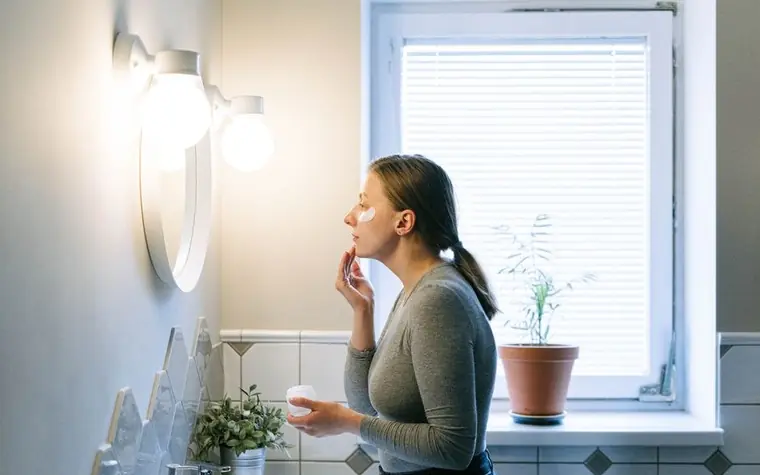
Because sebum shifts more predictably than TEWL, the safest seasonal adjustment is usually to the oil-control side of a routine rather than assuming hydration needs follow the same curve every year. This is also why oily skin and dehydrated skin aren't opposites: a face producing more sebum in summer can still lose water quickly if the barrier is compromised, and a sebum reading alone won't tell you that.
A practical way to track your own seasonal pattern
Skip generic seasonal skincare advice and track your own skin instead. Note when your face feels oilier by midday, when a moisturizer that worked one season suddenly feels too heavy or too light, and whether any reactivity clusters around specific months. Because a humectant, occlusive, or emollient behaves differently as ambient humidity changes, adjusting which of the three dominates your moisturizer by season is more reliable than switching your whole routine based on a seasonal skin-type label.
Bottom line
1. Sebum output has a fairly consistent seasonal pattern -- higher in summer, lower in winter, across multiple studies.
2. TEWL research is inconsistent -- direction of change depends on body site, population, and indoor climate control.
3. Sensitive skin shows more pronounced seasonal shifts than non-reactive skin in comparative studies.
4. Combination skin may reflect seasonal sebum patterns showing up unevenly across facial zones, not two fixed skin types.
5. Adjust the oil-control side of your routine seasonally, and track your own skin's pattern rather than following generic seasonal advice.
This article summarizes published skin biophysics research and does not diagnose or treat any skin condition. If seasonal reactivity is severe or persistent, consult a dermatologist rather than adjusting products on your own.
All content is fact-checked under our editorial standards.