
How Much Sunscreen Is 2 mg/cm²? The Dose the SPF Number Was Measured At — and the Two-Finger Rule
SPF is not a property of a formula. It is a measured result, and every measurement has conditions. The condition that matters most, and that almost nobody reproduces at home, is the amount applied: 2 mg/cm². That figure is written into ISO 24444, the in-vivo method behind the SPF number on most Korean, European and Japanese labels. Studies of how much people actually apply put real-world use somewhere between roughly 0.39 and 1.0 mg/cm². The gap between the tested dose and the applied dose is the single largest variable in whether a sunscreen performs anything like its label.
What the number on the bottle actually is
SPF is a ratio: the UV dose needed to produce minimal erythema on protected skin divided by the dose needed on unprotected skin, on the same person. ISO 24444 standardises the test — panel selection, the light source, the reading interval, and the application of 2 mg per square centimetre of test site, spread within a set time. Change the applied amount and you are no longer measuring the same thing.
Korea's Ministry of Food and Drug Safety builds its functional-cosmetics review on the same international methods, and in August 2026 announced a revision adding in-vitro options (ISO 23675 for SPF, ISO 24443 for PA) alongside the existing in-vivo methods, using PMMA plates rather than human panels. The application dose is not what is changing; the test substrate is. The 2 mg/cm² reference stays.
2 mg/cm² is a thickness, not a volume
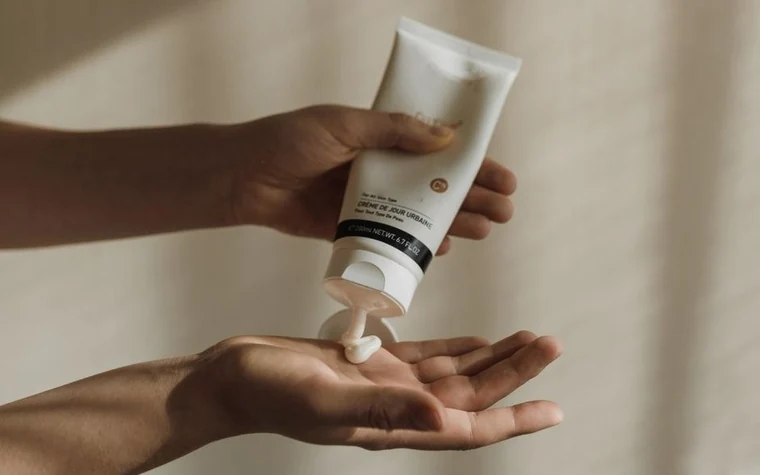
Because it is expressed per unit of area, the amount you need scales with how much skin you are covering — not with how oily you are or how hot it is. An adult face and neck is on the order of 500–600 cm², which lands the required dose in the range of roughly 1.0–1.2 g. In household terms that is close to a third to a half of a teaspoon for face and neck alone, and that is before ears, hairline and the back of the neck.
Most people find that number surprising, and the surprise is the point: the amount that feels correct — a pea, a fingertip, "enough to disappear" — is a fraction of the tested dose. A formula that disappears at the right dose is doing something a formula that has to be rubbed in for a minute is not.
What people actually apply
Reviews of application studies put typical real-world amounts in the region of 0.39 to 1.0 mg/cm², depending on the setting, the product format and whether participants knew they were being observed. That is a quarter to a half of the tested dose. It is remarkably consistent across studies, populations and decades, which suggests it is not an information problem so much as a sensory one: people apply until the skin feels covered, and skin feels covered well before it is.
Sprays and sticks tend to land at the low end of that range, lotions and creams at the higher end. Sunscreens that leave a visible cast are, ironically, easier to dose correctly, because you can see where you have not been.

Half the dose is not half the protection
This is where intuition fails. Protection does not fall in proportion to the amount applied — the relationship between applied thickness and measured SPF is steep and non-linear, so halving the dose costs considerably more than half the protection. In vivo studies that vary the application amount and re-measure SPF consistently find that under-application at typical real-world levels drops the effective figure to a small fraction of the labelled one.
The practical reading is not "SPF 50 is really SPF 17" — the exact figure depends on the formula and the study. The reading is that dose is a bigger lever than label number. Applying an SPF 30 properly beats applying an SPF 50 thinly, and buying a higher SPF is the cheapest way to buy nothing at all if the application habit does not change.
The two-finger rule, and where it comes from
The most-cited practical fix comes from a 2002 letter in the BMJ by Taylor and Diffey. Divide the body using the rule of nines, and for each of those areas squeeze two strips of sunscreen along the index and middle fingers, from the crease at the base of the finger to the fingertip. That quantity approximates the 2 mg/cm² used in the laboratory determination of SPF.
For the face and neck as a single area, the two-finger measure is the usable version of the teaspoon guidance published around the same time. It is not exact — finger size varies, and product viscosity changes how a strip lies — but it is repeatable, which is the property that matters. A rule you can perform without a scale beats a number you cannot verify.
A second method that works well with the thinner, fluid textures common in Korean sunscreens: apply in two full passes rather than one. Do the whole face, wait for it to set, then do it again. Two passes at a comfortable amount get most people closer to the target than one deliberate heavy layer, which tends to be spread thin under the hand.
Why the last step of a routine is the one most often under-applied
Sunscreen sits at the end of the morning routine, on skin that already has essence, serum and moisturiser on it. Two things happen there. The surface is already slick, so product spreads further with less resistance and feels sufficient sooner. And the step is competing with a schedule — it is the layer applied while looking for keys.
Both are dosing problems, not formula problems. If a sunscreen pills over a particular moisturiser, the usual response is to use less of it, which is precisely the wrong adjustment; the better one is to change what sits underneath. The order of a routine and the waiting time between steps are worth revisiting for that reason alone. For skin that already runs oily, note that surface oil does not reduce the amount of sunscreen needed — sebum output changes how a product feels, not how much UV it absorbs.
Reapplication is a dose problem too
Reapplication guidance is usually given as a timer — every two hours. The mechanism behind it is loss: rubbing, sweating, towelling and, in water, wash-off. What is being restored is the film thickness, which means a reapplication that uses less product than the first application does not return you to the starting point.
Two implications follow. Indoors, away from windows, the two-hour clock is doing less work than it appears to, because little is being lost. Outdoors, in water, or after wiping the face, the loss is real and the reapplied amount has to match the original — which is the argument for carrying a format you will actually use at volume rather than one that is convenient but applied sparingly.
The short version
SPF is measured at 2 mg/cm² under ISO 24444; real-world application is roughly a quarter to a half of that; the protection lost is disproportionately larger than the product saved. Use the two-finger measure per body area, treat face and neck as needing roughly a third to a half of a teaspoon, and apply in two passes if the texture is thin. Filter choice matters less than dose — even a genuinely new UV filter is subject to the same arithmetic.
Patch-test any new product on a small area before applying it to the whole face, and see a board-certified dermatologist for concerns about your skin, for sun-damage assessment, or before changing anything on medical advice. This article describes measurement methods and application amounts; it is not a diagnosis or a treatment recommendation. Sources: ISO 24444 (in vivo determination of SPF); Taylor S, Diffey B, BMJ 2002 (two-finger rule); published reviews of sunscreen application amounts under natural conditions; Korea MFDS announcement on in-vitro SPF/PA test methods, August 2026. Verified August 2026.
All content is fact-checked under our editorial standards.