Why Your Skincare Label Suddenly Lists More Allergens: The EU's 82-Substance Fragrance Rule
If a moisturizer bought this month lists "linalool" or "citral" in parentheses after the fragrance line, and last year's bottle of the same product didn't, that isn't a reformulation — it's a labeling deadline. The EU's fragrance allergen list, unchanged since 1999, just expanded from 26 substances to 82, and the first compliance deadline for newly launched products passed on July 31, 2026. Products already sitting on shelves have until 2028. Here is what actually changed, and why it shows up on Korean skincare even when the brand never sold a single unit in Europe.
The rule that stood still for 25 years
Since 1999, EU cosmetics regulation has required 26 specific fragrance substances — things like limonene, linalool, citral, geraniol, eugenol, and coumarin — to be listed individually by name on a product's ingredient list, rather than hidden inside the generic word "fragrance" or "parfum." This list was carried forward unchanged into Regulation (EC) 1223/2009, the current EU cosmetics framework, for over two decades while the science of contact allergy kept moving.
Why those 26 were picked — it isn't about toxicity
The original list wasn't built from a danger ranking. It came from patch-test data — dermatology clinics tracking which fragrance materials most frequently triggered allergic contact dermatitis in people already sensitized to fragrance. A substance's presence on the list says a meaningful number of people react to it, not that it's unsafe for everyone. Citrus essential oils naturally contain limonene and linalool at levels well above the labeling threshold, which is why plenty of "clean," essential-oil-based formulas have always carried these names on the back of the bottle — the same logic that makes an extract like centella asiatica worth reading past the marketing name for.
What the expansion to 82 actually adds
Regulation (EU) 2023/1545, published in July 2023, added 56 new substances to the list and updated the status of some existing entries, bringing the total to roughly 82 (sources differ between 81 and 82 depending on how updated versus new entries are counted). Many of the additions are natural extracts and essential oil constituents that patch-test data has linked to sensitization since the original list was drafted — the update reflects a quarter-century of additional clinical evidence, not a sudden new risk.
The threshold that makes trace amounts show up on the label
Labeling is required once a listed allergen exceeds 0.001% in leave-on products (creams, essences, serums) or 0.01% in rinse-off products (cleansers, shampoos). At 0.001%, that's 10 parts per million — a level small enough that a fragrance blend can trigger labeling for several of these substances without anyone perceiving it as "heavily scented." This is also why a product marketed as having a light, natural scent can still carry four or five individually named allergens: essential oils are chemically complex, and a single drop of citrus or lavender oil brings multiple listed compounds with it.
Two deadlines, not one
The compliance timeline runs in two stages. Any product placed on the EU market for the first time after July 31, 2026 must already carry the expanded 82-substance labeling — that deadline has now passed. Products that were already on shelves before that date get a longer runway: they can continue selling under the old 26-substance labeling until July 31, 2028. In practice this means two versions of the same formula's label can legally coexist for the next two years, depending on when that particular batch was first placed on the market — a reminder that even routine, well-established products can change their fine print without the formula itself changing at all.
Why this shows up on K-beauty labels without an EU launch
Brands that sell into the EU alongside the US, UK, or Asian markets rarely maintain separate ingredient panels per region if they can avoid it — it's cheaper and simpler to print one INCI list that satisfies the strictest regime and use it everywhere. That's the same dynamic that made GDPR-style privacy notices show up on websites with no European users. A Korean brand with even modest EU distribution has an incentive to adopt the 82-substance labeling globally, which is why a jar bought in Seoul or shipped from a Korean retailer can already reflect a rule that, on paper, only the EU requires.
What this means if you have known fragrance sensitivities
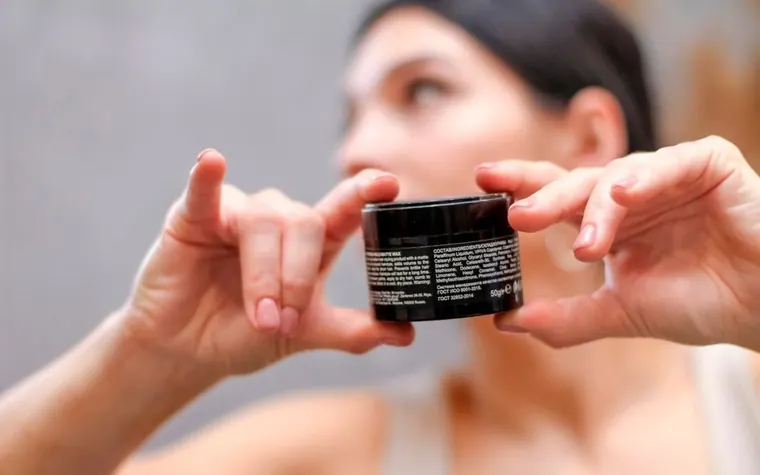
For someone with a documented reaction to a specific fragrance compound, the practical upside is real: a longer, more specific ingredient list gives you more to check before buying, rather than a single opaque word. "Fragrance-free" marketing claims are not a substitute for reading that list, since a product can be free of added synthetic fragrance and still contain naturally-derived allergens from a plant extract or essential oil used for a non-scent purpose. Anyone with a history of contact dermatitis from a specific botanical ingredient should look for that ingredient's name directly, not just the word "fragrance," on both old- and new-format labels. It's a similar habit to the one worth building around reactive, easily-irritated skin generally — the label rarely volunteers the detail that actually predicts a reaction.
The short version
The EU's fragrance allergen labeling list grew from 26 substances to roughly 82 under Regulation (EU) 2023/1545, based on patch-test evidence gathered since the original 1999 list. New products launched after July 31, 2026 must use the expanded list; products already on the market have until July 31, 2028. The 0.001%/0.01% concentration thresholds that trigger labeling stay the same, and many Korean brands are already applying the expanded list globally rather than maintaining a separate EU-only version.
If you have a known fragrance allergy or sensitive, reactive skin, check the full ingredient list rather than relying on "fragrance-free" claims, and see a board-certified dermatologist for patch testing if you suspect a specific reaction. This article describes a labeling regulation and is not medical advice. Sources: Regulation (EC) No 1223/2009 and amending Regulation (EU) 2023/1545, Annex III (European Commission); industry compliance summaries on the July 2026 and July 2028 transitional deadlines. Verified August 2026.
All content is fact-checked under our editorial standards.