
Combination Skin, Explained: The Seasonal Mismatch Rule a Sebumeter Study Proposed
"Combination skin" is the most commonly claimed skin type and the least defined one. Dry, oily and sensitive all have at least a rough instrument behind them. Combination has usually meant something closer to a feeling: shiny forehead, tight cheeks, and a shopping decision made in front of a mirror at 9 p.m. That vagueness is not just annoying. It is the reason people end up buying two products that fight each other on the same face.

There is, however, a published attempt to give the term a measurable definition, and it is worth reading carefully — because the rule it proposes is not the one most people assume.
The study that tried to define the term
In 2005, Youn and colleagues published "Regional and seasonal variations in facial sebum secretions: a proposal for the definition of combination skin type" in Skin Research and Technology (2005;11:189–195). Their starting point was blunt: facial skin types have been categorized as oily, normal, dry and combination, but "these have been evaluated subjectively by individuals to date, and no objective accepted standard measurement method exists." Combination, they noted, was the most common type and the vaguest.
The method was simple and repeatable. Sebum secretion was measured with a Sebumeter at five sites on the face, in the same volunteers, seasonally across a full year. From that data set they built a rule for what should count as combination skin.
Three findings came out of it. Regional differences were confirmed: sebum on the forehead, nose and chin was higher than on both cheeks. Summer was the highest sebum-secreting season. And seasonal variation appeared in both the T-zone and the U-zone, not just one of them.
The proposed rule is about mismatch across seasons
Here is the sentence that matters, and the one almost never quoted: "A mismatch of skin type in the T- and U-zones in more than two seasons appears to be close to subjective ratings of what is described as the 'combination' skin type."
Read that again. The proposed definition is not "your T-zone is oily today." It is that the two zones classify as different types across more than two of the four seasons. The authors' conclusion is explicit: to define combination skin, seasonal variation must be considered in addition to regional variation.
This reframes a very common experience. If your forehead is shiny in July and your whole face is comfortable in October, that is not combination skin under this rule — that is a normal seasonal swing that everyone's face makes. Combination, measured properly, means the gap between zones persists when the season changes.
Why the T-zone and U-zone differ in the first place
The regional split is anatomical, not behavioral. Sebaceous gland density is not uniform across the face: it is dramatically higher on the forehead and scalp than on the cheeks. Measurement zones in this literature are conventionally grouped as the T-zone (forehead, nose, chin) — the high sebum-secreting region — and the U-zone (both cheeks) — the low one.
Regional differences in androgen susceptibility have also been reported, meaning the same hormonal signal does not produce the same sebum output in every part of the face. The practical consequence is that nothing you apply topically will equalize the two zones. You are not correcting an imbalance; you are managing a permanent gradient built into where the glands sit.

What this changes about buying products
If the gradient is structural and the diagnosis is seasonal, three habits stop making sense.
- Buying a "combination skin" product. There is no formula that is simultaneously more occlusive on the cheeks and less occlusive on the forehead. A product labelled for combination skin is a compromise placed somewhere in the middle, which is a legitimate choice — but it is a compromise, not a solution to two different measurements.
- Re-diagnosing yourself every few weeks. Under the proposed rule, a single reading in August tells you very little. Summer is the highest sebum season for everyone.
- Treating the whole face for the shiniest part of it. This is how cheeks get stripped. If the forehead drives your product choice, the U-zone absorbs the cost.
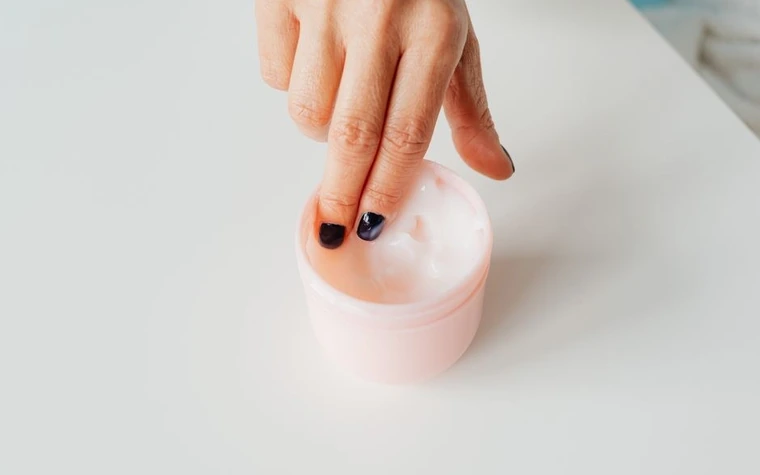
The alternative that follows directly from the data is zoned application: a lighter texture where sebum output is high, a richer one where it is low, using products you already understand. That is not a marketing category, it is just applying different amounts to different areas. If you are unsure which shortage you are actually treating on the cheeks, the distinction in dry skin versus dehydrated skin is the one to settle first, because oil and water are not interchangeable here.
Do not confuse a combination pattern with oiliness
A shiny T-zone alone does not make skin oily, and the reverse also holds. Oily skin has its own measurable behaviors — including a temperature relationship and a surface reservoir that washing does not empty — which are covered separately in what the oily-skin measurements actually show. Combination is defined by the gap between two regions, not by the absolute level in either one. Two people can have identical forehead readings and only one of them fits the combination definition, because the difference is in the cheeks.
Pore visibility follows the same gradient and gets misread the same way, which is why it clusters on the nose and inner cheeks; the measurement side of that is in what pore studies actually measured.
Seasonal adjustment, done from measurements rather than mood
Because summer was the peak sebum season in this data and the seasonal swing appeared in both zones, an autumn routine change is defensible — but the direction should be specific. What usually needs to change first is the cleanser and the cheek moisturizer, not the whole routine. The T-zone rarely needs a different product in October; it needs less of the summer one.
A cheap way to gather your own data: blot the forehead and one cheek with separate sheets at the same time of day, several times across a month, and note whether the two sheets look different in the same way every time. It is a crude proxy for a Sebumeter, but it tests the right thing — the persistence of the gap, which is what the proposed definition rests on.
One thing that does not need to change by zone is the sequence. Whichever textures you settle on, the order in which they go on the face follows the same logic everywhere, and the parts of that logic with evidence behind them are set out in what the layering-order research actually supports.
What the evidence does and does not support
- Supported: sebum output is measurably higher on the forehead, nose and chin than on the cheeks.
- Supported: sebum secretion varies by season, with summer highest, in both the T- and U-zones.
- Proposed, not settled: that "combination skin" should be defined as a T-/U-zone mismatch persisting in more than two seasons. This was a proposal from a single study of the same volunteers measured across one year, not an adopted international standard.
- Not supported by any of this: that a product can permanently change how much sebum a region produces, or that a shiny T-zone means the cheeks need the same treatment.
How to use this
- Stop diagnosing in summer only. The season with the highest sebum output is the worst one to classify from.
- Test the gap, not the level. Compare forehead against cheek on the same day, repeatedly.
- Assume the gradient is permanent. Gland distribution is anatomy; manage it, do not try to erase it.
- Apply by zone, not by label. Two textures you understand beat one product marketed at a category.
- Change one variable in autumn. Usually the cleanser or the cheek moisturizer. Watch for a month before changing anything else.
Patch-test any new product on a small area before applying it broadly, and see a dermatologist for any skin condition that is persistent, painful or changing.
All content is fact-checked under our editorial standards.