
Enlarged Pores, Explained: What the Measurements Actually Show
Pores are the most photographed and least measured thing in skincare. Almost every claim you read about them — that they open with steam, close with cold water, shrink with an ingredient — describes an anatomy that does not exist. A pore has no muscle and no door. What researchers have actually measured is narrower and more useful: what correlates with how large a pore appears, and how much of that is fixed before you buy anything.

What the word "pore" is describing
In cosmetic and dermatological literature, a facial pore is the visible surface opening of a pilosebaceous unit — a hair follicle with its sebaceous gland attached. The opening is a hole in a structure, not a valve. There is no sphincter around it and no contractile tissue to tighten. Anything that claims to open or close a pore is describing something that has not been demonstrated to exist.
This matters because it reframes the whole question. You are not trying to change the diameter of a follicle. You are trying to change how visible its opening is in ordinary light, which is a different and much more tractable problem.
Sebum output was the strongest correlate measured
The reference study here is Roh and colleagues, published in the British Journal of Dermatology in 2006 (volume 155, pages 890–894). They recruited 60 volunteers — 30 men and 30 women — photographed pores with a dermoscopic video camera, and measured them with image analysis software rather than by eye.
What tracked with larger pore size was higher sebum output, older age, and male sex. In women, hormonal factors including the phase of the menstrual cycle also affected the measurement. That last finding is the one worth sitting with: if the same face measures differently at two points in the same month, a product tested across those weeks can appear to work when nothing has changed.
Ethnicity accounted for more variation than age did
The largest dataset on this comes from Flament and colleagues, published in Clinical, Cosmetic and Investigational Dermatology in February 2015. Using a polarized-light dermatoscope coupled to a digital camera, the team recorded pore size, density and skin coverage on the cheeks of 2,585 women across Brazil, China, France, India and Japan.
Their conclusion was that variation in pore size was more strongly associated with ethnic differences than with differences in age. A separate study — Sugiyama-Nakagiri and colleagues, Journal of Dermatological Science, 2009, volume 53 — took surface replicas from 80 women aged 30 to 39 across four ethnic groups living in the same city, then used in vivo confocal laser scanning microscopy to look beneath the surface. Pore sizes differed between groups, and so did the epidermal architecture around the opening.
Visibility is partly an optics problem
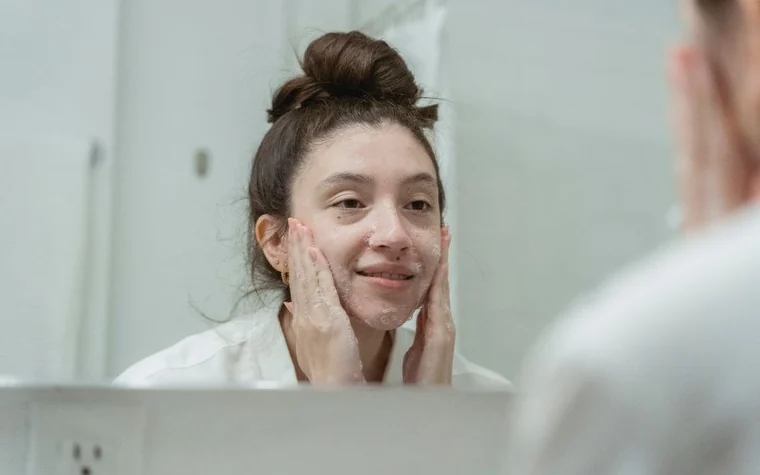
Two faces with identically sized pores can photograph very differently, because what you see is a shadow. A depression in a surface catches light on one rim and casts a shadow into the opening; the greater the contrast between the two, the more the pore reads as a dark dot. Overhead lighting and low ambient fill make this worse, which is why bathroom mirrors are unkind and diffuse daylight is flattering.
This is the same physics that sits underneath the glass skin look, where the goal is to raise specular reflection off a smooth surface. Nothing about that changes follicle diameter. It changes how much of the incoming light bounces off the top rather than falling into the depressions.
What is sitting in the opening
The visible content of a pore is a mixture of sebum and shed corneocytes. Sebum output is measurable and varies with temperature and time of day, which is covered in more detail in our piece on oily skin. Because that content sits at the surface, cleansing chemistry is the part of a routine that touches it most directly — the reasoning behind an oil step is set out in double cleansing.
One boundary is worth drawing clearly. Persistent blackheads, whiteheads and inflamed lesions are acne, which is a medical condition with medical management. This article is about the appearance of ordinary pores, not about treating acne. If that is what you are dealing with, a dermatologist is the correct next step and cosmetic products are not a substitute for one.
What a cosmetic can and cannot claim
Cosmetics are regulated as products that clean, beautify and alter appearance. They are not permitted to claim they treat or prevent a condition, and "shrinks pores" sits awkwardly close to that line. What is defensible is an appearance claim: the product changes how visible a pore looks while it is on the skin.
Ingredients studied in this general area are usually discussed in terms of sebum-related or surface-texture effects. Niacinamide is the most commonly cited — what was actually measured at 2%, 5% and 10% is set out in our niacinamide breakdown. Note the framing throughout: measured outcomes at stated concentrations, not rankings and not promises.
How to read a before-and-after honestly
Three things make pore photographs unreliable. Lighting angle changes shadow depth, and shadow is most of what you are looking at. Timing matters because sebum output shifts with temperature and, for women, across the cycle — the Roh study found exactly that. Camera distance and focus alter apparent size at these scales more than any product does.
If you want a comparison you can trust on your own face, fix the position, the light source and the time of day, and leave at least four weeks between shots. Anything less is measuring the room, not the skin.
The short version
Pores have no mechanism to open or close. Measured pore size correlates with sebum output, age and male sex, and in women shifts across the menstrual cycle. Across 2,585 women in five countries, ethnicity explained more of the variation than age did. What a routine can realistically change is surface sebum, texture and the way light falls — not the diameter of a follicle. Judging a product on that basis makes the disappointment much less likely.
Patch-test any new product on a small area before applying it to the face, and see a dermatologist for persistent congestion, inflamed lesions or any worsening skin concern — this article is general information about how pore appearance is measured, not a diagnosis or treatment recommendation.
All content is fact-checked under our editorial standards.