
In What Order Should You Apply Skincare? The Parts With Evidence Behind Them
Almost every K-beauty routine graphic gives the same instruction — thinnest to thickest, wait twenty minutes between steps, acids at night. Some of that traces back to published measurement. Some of it is a rule someone invented that then got copied for fifteen years. The useful version of "what order" is narrower than the graphics suggest: a handful of steps where sequence provably changes what reaches the skin, and a long tail where it does not.
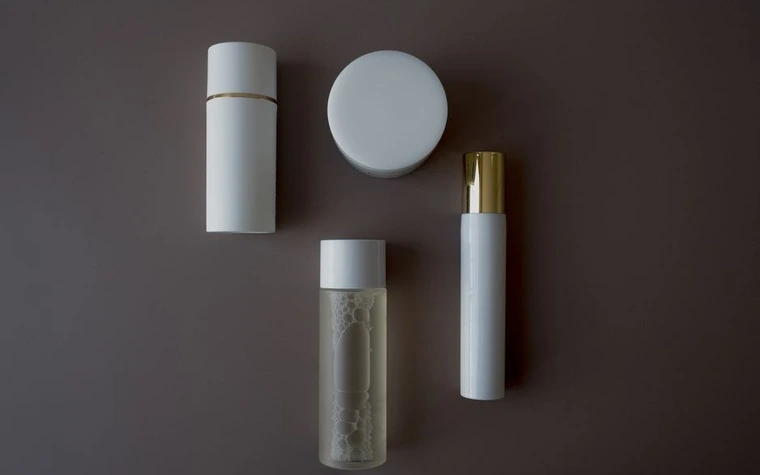
Only three things determine order
Strip the charts down and there are three real variables. pH — a few ingredients only work inside a narrow acidity window, and whatever you put on first sets that window. Occlusion — a film-forming layer slows what crosses it, so anything meant to reach the skin goes underneath it. Surface film — one category is designed to sit on top and stay there, and covering it defeats its purpose.
Everything else in a routine — essence, toner, eye product, sheet mask — is largely order-agnostic. It is not that these steps are useless; it is that no measurement supports a fixed position for them. If a chart tells you an essence must precede a serum, ask what was measured.
The pH case: L-ascorbic acid
The clearest evidence-backed ordering rule comes from Pinnell and colleagues' percutaneous absorption work published in Dermatologic Surgery in 2001. Their finding was specific: L-ascorbic acid must be formulated below pH 3.5 to be absorbed into skin at all. Above that threshold, absorption dropped sharply.
Two more numbers from the same study are routinely misquoted. The maximum useful concentration was 20% — going higher did not increase what got in. And skin tissue levels saturated after three daily applications, with a tissue half-life of roughly four days. Which means the difference between a good vitamin C habit and a perfect one is smaller than the marketing implies, and once saturated, more product on a given morning adds nothing.
The practical rule that follows: put a low-pH ascorbic acid formula on clean skin, first. Applying it over a layer that raises surface pH works against the one condition the study identified as necessary. This is a formulation-chemistry argument, not a claim about outcomes on your face.
Sunscreen goes last, and the reason is measurable
Sunscreen is the surface-film category. Its labelled SPF is measured under a specific condition: 2 mg/cm² of product, spread as an even layer. Change the layer and you change the number.
Faurschou and Wulf quantified this in the British Journal of Dermatology in 2007. They marked five 34 cm² areas on the backs of 20 volunteers and applied an SPF 4 sunscreen at 0.5, 1, 2 and 4 mg/cm². The relationship between amount and protection followed exponential growth (r² = 0.903). In their terms: at 1 mg/cm² the SPF falls to the square root of the labelled value, and at 0.5 mg/cm² to the fourth root.
Run that on a familiar number. An SPF 50 applied at half the test amount behaves like roughly SPF 7 by that relationship; at a quarter, closer to SPF 2.7. This is why "apply enough" outranks every other sunscreen decision, and why anything rubbed on top — a cushion, a powder, a moisturiser reapplied at noon — should be treated as an addition to the film, not a replacement for it.

Occlusives go on top, but they are not a lid
The "thickest last" instruction is roughly right, and the mechanism is more interesting than the rule. Ghadially and colleagues examined petrolatum's effect on the stratum corneum in the Journal of the American Academy of Dermatology in 1992 and found it does not behave as an impermeable membrane sitting on the surface. It permeates the interstices between corneocytes, and barrier recovery proceeded normally underneath it.
That matters for two reasons. First, an occlusive layer is not a sealed lid, so the fear that a heavy cream "traps" everything under it and forces it through is overstated. Second, an occlusive is still the layer that slows evaporation most, so a water-based step applied over it has less reason to be there. Water-phase products first, oil-phase and film-formers last, is a defensible order.
The wait times are mostly invented
"Wait twenty to thirty minutes between steps" has no measurement behind it that survives scrutiny. What has some basis is much shorter and much narrower: giving a low-pH formula a couple of minutes on clean skin before covering it, for the pH reason above.
The real cost of long wait times is not chemical, it is behavioural. A ten-step routine with mandated pauses takes forty minutes, and routines that take forty minutes get abandoned. A four-step routine performed nightly outperforms an eight-step routine performed twice a week, and none of the layering literature contradicts that.
Two layers deep is usually the ceiling
There is a practical limit to how many actives can occupy the same square centimetre. Each layer dilutes and physically displaces some of the one under it, and formulas are developed as finished products, not as base coats for whatever goes on next.
A more reliable structure is to separate by time rather than stack by order: one active in the morning, one at night, each with the supporting steps it needs. This removes most of the "can I use X with Y" question without requiring you to adjudicate ingredient-compatibility claims that were never tested in the combinations being sold. The specific niacinamide concentrations and what each was measured for are covered in niacinamide, explained.
Where the routine question stops
Layering order is a cosmetic-formulation question. It stops at the point where a persistent skin condition begins. Ordering, waiting, and stacking are not tools for treating acne, rosacea, eczema, or pigmentation disorders, and a routine that is "correctly sequenced" does not become a treatment. Those belong with a dermatologist, who can also tell you which products to stop while a prescribed regimen is running — a question no chart can answer.
What a good order does accomplish is smaller and real: it keeps a pH-dependent ingredient in the condition it was formulated for, and keeps the sunscreen film intact. That is most of the available benefit.
The short version
- Cleanse. Anything pH-dependent goes on first, on dry skin, and gets a minute or two.
- Water-phase steps next, in whatever order suits you — sequence here is not measurable.
- Oil-phase and occlusive layers last in the evening.
- In the morning, sunscreen is the final layer, and the amount matters more than anything preceding it.
- Split actives across morning and evening rather than stacking three in one sitting.
- Ingredient explainers live in Ingredients Explained; how these rules get marketed is in K-Beauty Trends; adjusting the structure by skin type is in Skin Types.
Study details above are drawn from published cosmetic-dermatology literature: Pinnell et al., Dermatologic Surgery (2001) on L-ascorbic acid percutaneous absorption; Faurschou and Wulf, British Journal of Dermatology (2007) on sunscreen quantity and SPF; Ghadially et al., Journal of the American Academy of Dermatology (1992) on petrolatum and stratum corneum function. Results in controlled studies describe averages across a group and are not a promise for any individual. Patch-test any new product on a small area before applying it to the face, and consult a dermatologist for persistent or worsening skin concerns.
All content is fact-checked under our editorial standards.