
Vitamin C and Niacinamide in the Same Routine, Explained: Why the 'Don't Combine Them' Rule Traces to a 1944 Beaker, Not Your Skin
"Never combine niacinamide and vitamin C" is a routine rule with a real chemical source. What got lost on the way to a graphic is the pH and timescale that reaction needed -- neither describes two products applied minutes apart on a face.
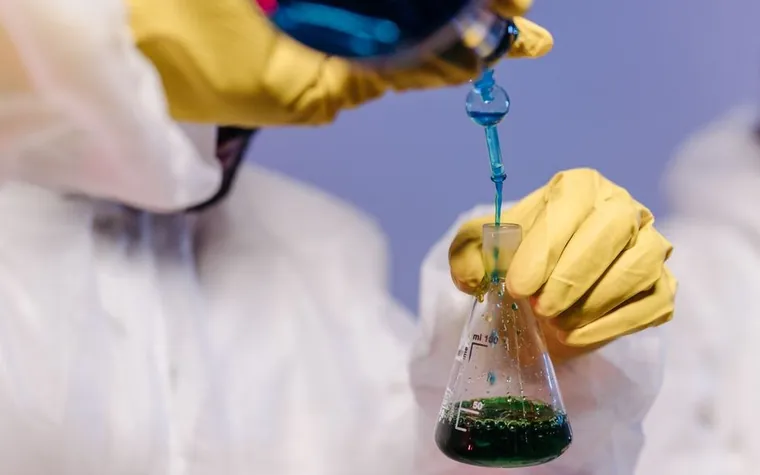
A 1944 color change, not a skin study
The earliest report, in Proceedings of the Society for Experimental Biology and Medicine, noted a canary-yellow color forming when ascorbic acid and nicotinamide were moistened and stirred together -- a color shift in a dilute solution, no activity loss, no nicotinic acid measured.
The 1963 paper that characterized it
A 1963 Journal of Pharmaceutical Sciences study (Guttman) identified what forms: a reversible 1:1 complex between protonated nicotinamide and the ascorbate anion, peaking near pH 3.8 -- two intact molecules loosely paired, not one destroying the other.
Why pH 3.8 isn't a coincidence
Pure L-ascorbic acid needs a low formulation pH, roughly below 3.5, to stay in its skin-penetrating free-acid form -- close to that pH-3.8 peak. That's why one product at that pH is a harder formulation problem than two products in sequence.

What "flushing" refers to
The niacin flush people cite is a systemic response to oral doses of tens to hundreds of milligrams. A trace complex between two topical ingredients at cosmetic concentrations is a different dose and route entirely.
Why modern pairings mostly sidestep it
Sodium ascorbyl phosphate and magnesium ascorbyl phosphate are formulated near skin-neutral pH, outside the range where that complex forms at any meaningful rate.
Does sequencing still matter?
Only at the margins. With pure, low-pH vitamin C, letting it absorb before the next step protects that step's low pH -- it isn't avoiding a skin reaction. A buffered derivative, or one serum with both, has no such conflict to protect.

Quick Recap
- The rule traces to a 1944 color-change report in a stirred solution -- no activity loss, no nicotinic acid measured.
- A 1963 study (Guttman) found a reversible complex peaking near pH 3.8, not a destroyed active.
- That pH is close to where pure L-ascorbic acid is formulated -- the real reason for the caution.
- Niacin "flush" is an oral, high-dose response, not a documented topical reaction at cosmetic doses.
- Buffered vitamin C derivatives near skin pH mostly avoid this chemistry.
- Separating the two protects vitamin C's low pH, not your skin from a reaction.
Sources: Proc. Society for Experimental Biology and Medicine (1944); Guttman, J. Pharmaceutical Sciences (1963); dermatology literature on L-ascorbic acid's pH requirement; pharmacology references on oral niacin flush. This explains formulation chemistry, not medical advice. Patch-test any new product first, and see a board-certified dermatologist about any persistent irritation.
All content is fact-checked under our editorial standards.