
Vitamin C, Explained: L-Ascorbic Acid, pH, and Why the Derivatives Are Not the Same Molecule
Vitamin C is the ingredient people give up on most often, and usually for the same reason: they bought something labelled vitamin C, used it for a month, and nothing happened. The label was probably accurate. The problem is that "vitamin C" on a skincare box can mean at least half a dozen different molecules, formulated at pH values that differ by four orders of magnitude in acidity, and the research behind the famous numbers applies to exactly one of them. This is what was actually measured, and where the differences sit.
Only one form is the vitamin itself
L-ascorbic acid (LAA) is vitamin C. Everything else on an ingredient list — sodium ascorbyl phosphate, magnesium ascorbyl phosphate, 3-O-ethyl ascorbic acid, ascorbyl tetraisopalmitate, ascorbyl glucoside — is a derivative: a modified molecule that has to be converted back into ascorbic acid by the skin before it can do anything vitamin C does.
That conversion step is where the honesty has to sit. Derivatives are more stable, less acidic, and generally more comfortable. What is far less well established is how much of the applied derivative actually converts in human skin under real use. So a jar labelled "15% vitamin C derivative" and a serum labelled "15% L-ascorbic acid" are not comparable quantities, even though the numbers look identical.
The pH number is not a marketing detail
The classic percutaneous absorption work on topical vitamin C is Pinnell and colleagues, published in Dermatologic Surgery in 2001. Two findings from it have shaped every LAA serum on the market since.
- L-ascorbic acid must be formulated at a pH below 3.5 to enter the skin. Above that, the molecule carries a charge and does not cross the stratum corneum well.
- Absorption increased with concentration up to a maximum around 20%. Going higher did not deliver more.
Two more details from the same work are less quoted and more practically useful: skin levels were saturated after three daily applications, and the half-life of tissue disappearance was around four days. Which means daily use makes sense, twice-daily use is unlikely to add much, and skipping a couple of days is not a reset.
This is also the reason LAA serums sting on some skin and not on others. The low pH is not incidental — it is the delivery mechanism. Removing it removes the point.
Why 15%, 1% and 0.5% keep appearing together
That trio of numbers comes from a specific formulation studied at Duke: 15% L-ascorbic acid with 1% alpha-tocopherol (vitamin E) and 0.5% ferulic acid.
Ferulic acid was added as a stabiliser, and the published result was that it did two things at once. Stability improved sharply — after one month at 45°C, taken as a proxy for about a year at room temperature, over 90% of the L-ascorbic acid and effectively all of the tocopherol remained. And photoprotection roughly doubled, from about four-fold to about eight-fold, measured by erythema and sunburn cell formation.
Two caveats keep this in proportion. Eight-fold protection against free-radical damage is not eight-fold protection against UV, and an antioxidant is not a sunscreen. It works on the oxidative damage that gets through, which is why the whole category is discussed as something you layer under SPF rather than instead of it. Where it sits in the morning sequence, and why, is covered in the order of application.
The colour of the bottle tells you something real
L-ascorbic acid oxidises. As it does, it converts to dehydroascorbic acid and the solution turns from clear or pale straw to yellow, then amber, then brown. This is one of the few cases in skincare where a visual change is a genuine chemical signal rather than a cosmetic quirk.
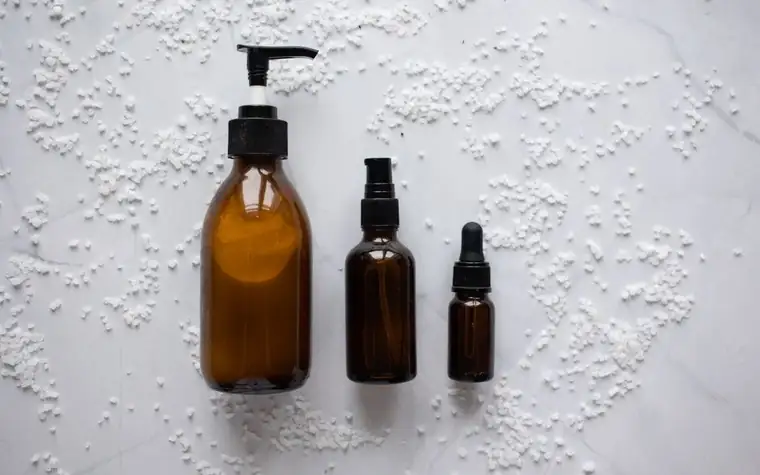
A serum that has gone amber has lost some of what you paid for. It is not dangerous, but it is weaker, and a brown one is largely spent. This is why the well-formulated products come in opaque or amber glass, often airless, in small volumes — and why buying a large bottle to save money tends to be a false economy. Keep it away from light and heat, and treat a few months after opening as the working window.

What the derivatives are for
Derivatives exist because the LAA formula is genuinely difficult: acidic, unstable, and irritating to some people. Each one trades something.
| Form | Character | Trade-off |
|---|---|---|
| Sodium ascorbyl phosphate (SAP) | Water-soluble, stable near neutral pH | Comfortable; conversion efficiency in skin is the open question |
| Magnesium ascorbyl phosphate (MAP) | Water-soluble, stable, low irritation | Same conversion caveat; usually used at lower percentages |
| 3-O-ethyl ascorbic acid | Developed specifically as a stable derivative for topical use | Better stability than LAA; different penetration profile |
| Ascorbyl tetraisopalmitate (THD) | Oil-soluble, works in anhydrous formulas at neutral pH | Suits dry or reactive skin; expensive, and formulated at low percentages |
The practical reading: if low-pH LAA is uncomfortable on your skin, a derivative is a reasonable choice and a better one than abandoning the ingredient. Just do not expect the Pinnell numbers to transfer, because those numbers were measured on L-ascorbic acid. If discomfort is the reason you are looking at derivatives, it is worth checking whether the underlying issue is barrier-related first — the distinction in dry versus dehydrated skin changes what a low-pH serum feels like.
The niacinamide question
You will still read that vitamin C and niacinamide cancel each other out, or combine into niacin and cause flushing. The origin of that claim is laboratory work on unformulated solutions held at elevated temperature — conditions that are not what happens in a modern cosmetic emulsion, or on a face.
In practice the two are formulated together routinely, and the more realistic concern is simple tolerance: two active layers at once on skin that is already reactive. If you want to be cautious, separating them by time of day is a reasonable approach and costs you nothing. What niacinamide itself was measured doing, at which percentages, is set out in the niacinamide breakdown.
Reading a label without the marketing
- Find the form first. "Ascorbic acid" high in the list is LAA. Anything with -yl or -phosphate is a derivative.
- For LAA, look for a stated percentage and pH. If neither is disclosed, you cannot assess the product against the published work.
- Percentages above 20% are marketing, not delivery — absorption plateaued at 20% in the absorption study.
- Check the packaging. Clear bottles and wide-mouthed jars are a formulation decision, and not a favourable one.
- Ignore the shade of the liquid at purchase but watch it over time. Amber means declining.
- Introduce one active at a time, a few days apart, so you know what caused what.
Where all of this lands is fairly narrow and fairly firm. Topical vitamin C is well studied as an antioxidant that supplements the skin's own reservoir, and best evidenced as a partner to daily sunscreen rather than a replacement for one. Claims that reach beyond that — about clearing established pigmentation, treating a skin condition, or replacing a clinical procedure — are not what the absorption and photoprotection literature demonstrates. Related surface and shadow effects that look like pigmentation but are not are covered in the four types of dark circles.
Written with reference to Pinnell et al., "Topical L-Ascorbic Acid: Percutaneous Absorption Studies", Dermatologic Surgery 2001;27(2):137–142 (pH below 3.5 required for penetration; maximal absorption at 20%; tissue saturation after three daily applications; approximately four-day tissue half-life), and to published work on the 15% L-ascorbic acid / 1% alpha-tocopherol / 0.5% ferulic acid formulation reporting improved stability and an approximate doubling of photoprotection from four-fold to eight-fold, as of August 2026. Percentages cited are those used in the referenced studies, not product recommendations, and brands are not ranked or reviewed here. Patch-test any new product on a small area before applying it to the face, and take persistent irritation, redness, or a skin concern that is not settling to a dermatologist rather than to a change of serum. Nothing here is medical advice or a treatment recommendation.
All content is fact-checked under our editorial standards.