
Makeup Wipes, Explained: Where They Fit in the Evening Order, What the AAD Says About Removing Makeup, and Why the EU Banned One Preservative in Leave-On Wet Wipes
A makeup wipe is the shortcut step of an evening routine: one pad, no sink. What it does not come with is a clear place in the order, and its label rarely tells you which preservative keeps the pack from growing microbes. This guide covers where a wipe fits, what the American Academy of Dermatology (AAD) says about removing makeup, and what a North American patch-test review and the EU's 2017 rule say about preservatives in wet wipes.
What a wipe is, and what it is not
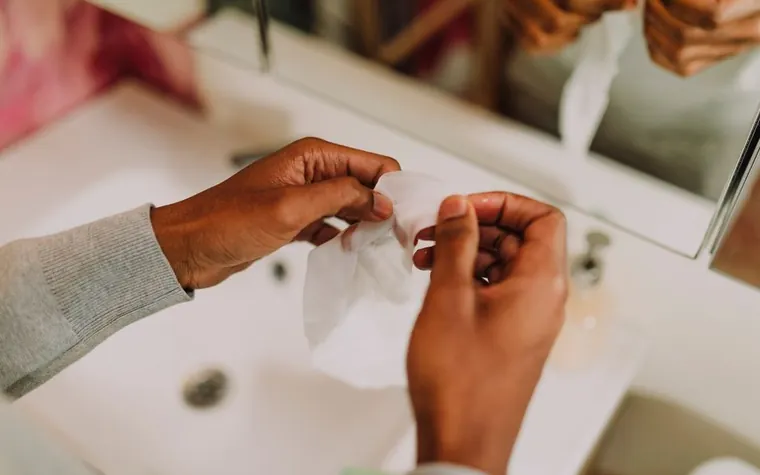
A wipe is a pad soaked in a lotion. The lotion carries surfactants to loosen makeup, water, and a preservative system, because a sealed, wet pack is an easy place for microbes to grow. It is a remover, not a full cleanse. Nothing in the sources we used measures how well wipes clean compared with a sink wash, so we do not rank them.
What the AAD tells you to do
The AAD's makeup page gives three plain steps: "Remove your makeup, including eye makeup, before going to bed." "Use an oil-free makeup remover." "After removing your makeup, wash your face with a gentle cleanser." Its washing advice adds lukewarm water. The page does not single out wipes, so any statement that "the AAD bans wipes" is wrong. What it gives you is an order: remove, then wash.
The order that follows
- Wipe the eyes and face to lift makeup and sunscreen
- Wash with a gentle cleanser and rinse with lukewarm water
- Moisturize as usual
This is the same remove-then-cleanse logic as double cleansing, with a pad in place of the oil. If you only ever wipe, the lotion stays on the skin. If the wipe is your "first cleanse," the cleanser is the second.

The preservative question
Wet wipes are a leave-on format, because nothing rinses them off. That matters because one preservative group has a documented allergy record. In a retrospective analysis of North American Contact Dermatitis Group data from 2011 to 2014 (Warshaw and colleagues, Dermatitis 2017, volume 28, pages 64-69), 79 of 9,037 patch-tested patients (0.9 percent) reacted to an allergen linked to a wet wipe. Among those 79, methylisothiazolinone (MI) accounted for 59.0 percent, methylchloroisothiazolinone with MI for 35.6 percent, bronopol for 27.4 percent and iodopropynyl butylcarbamate for 12.3 percent. Fragrance compounds accounted for another 12.3 percent.
What that number does and does not say
These were patients already referred for patch testing, so 0.9 percent is not the rate in the general population. The paper covers wet wipes as a group, and we found no facial-wipe breakdown in it. It also reports that anal and genital dermatitis was 15 times more likely in people with wet wipe allergy, which points to toilet and baby wipes as a main exposure. Treat it as a reason to read labels, not as a verdict on every makeup wipe.
What the EU did about it
The EU's Scientific Committee on Consumer Safety adopted its opinion on MI (SCCS/1521/13) on 12 December 2013 and revised it on 27 March 2014. Commission Regulation (EU) 2016/1198 followed. Its third recital states that for leave-on cosmetic products, including wet wipes, no safe concentration of MI had been demonstrated for induction or elicitation of contact allergy. The rule applied in full from 12 February 2017. In that regulation, MI stayed permitted in rinse-off products at up to 0.01 percent. We did not verify how US rules treat MI, so check the ingredient list wherever you buy.
How to use wipes with a lower risk of irritation
- Read the list for methylisothiazolinone, methylchloroisothiazolinone, bronopol and iodopropynyl butylcarbamate if you have reacted to a preservative before
- Choose fragrance-free pads if fragrance has bothered you
- Use a light hand around the eyes and close the pack after each pull, since a dried pad cannot be reused
- Follow with the wash step above, and see how often to wash in our face-washing guide
- For another rinse-or-not product, read our micellar water guide
A short evening order
Remove makeup with a wipe or remover, wash with a gentle cleanser and lukewarm water, then moisturize. Test a new wipe first with our patch test method, and stop using any product that stings or itches.
This article is educational and is not medical advice. Patch-test new products on the inner forearm, and see a dermatologist for a rash, persistent irritation or any skin condition.
All content is fact-checked under our editorial standards.