
How Long Should You Wait Between Skincare Steps? The One Wait With a Rule Behind It
Ask how long to wait between skincare steps and you will get numbers back with startling confidence. Thirty seconds. Sixty seconds. Five minutes. Twenty minutes, if the video is being especially firm about it. Almost none of these come from anywhere. But one wait in a skincare routine is written into federal regulation, it has a stated reason, and it is routinely misapplied to the wrong step. Sorting out which waits are load-bearing and which are ritual is mostly a matter of reading the one rule that exists.

The one wait that is codified
In the United States, sunscreen is an over-the-counter drug, and its label text is prescribed rather than written by marketing. Under 21 CFR 201.327(e)(1)(ii), the Directions on every sunscreen must instruct the user to "apply [liberally or generously] [and evenly] 15 minutes before sun exposure."
That is the only interval in a normal routine that a regulator has put a number on. It is not a suggestion from a brand, and it is not about how a product feels. It is a labelling requirement, and it applies to the product regardless of filter system, texture or country of formulation.
The 15 minutes exists because the SPF test waits 15 minutes
This is the part that makes the rule make sense. The same regulation sets out how SPF is measured. Under 21 CFR 201.327(i), the test product is applied to marked sites on human subjects at 2 mg/cm², spread as evenly as possible. Then, at paragraph (i)(4)(iv), headed Waiting period: "Wait at least 15 minutes after applying a sunscreen product before exposing the test sites to UV radiation."
So the SPF number on the bottle does not describe a wet layer of product. It describes a film that has had fifteen minutes to form, at a dose most people never apply. The label instruction is not a precaution bolted on afterwards — it is the condition under which the number on the front of the bottle was generated. Use the product differently and you are no longer inside the test that produced the claim.
Which is not a rule about layering
Here is where it gets misquoted. The fifteen minutes is a wait before UV exposure. It is not a rule that you must sit still for fifteen minutes before touching your face, and it is not a rule that fifteen minutes must elapse between sunscreen and anything else.
The practical translation is duller and more useful: apply sunscreen as the last step, then do something that is not going outside. Get dressed. Make coffee. The wait is meant to be absorbed by the ordinary gap between finishing a routine and leaving the house, and for most people it already is. The failure mode is not waiting fourteen minutes instead of fifteen — it is applying sunscreen at the door.
What "absorbing" actually means
The mental model behind most wait-time advice is that each product needs time to sink in before the next one arrives, or it will be blocked. That is not quite what happens on the surface.
A cosmetic formula is mostly carrier. When you apply a serum, what you observe over the next minute or two is largely volatile components evaporating — water, and in many textures light alcohols or volatile silicones. What remains is a thin residual film of the non-volatile ingredients. That film keeps working long after the surface stops feeling wet. Actives are not on a timer that expires when the next layer lands.
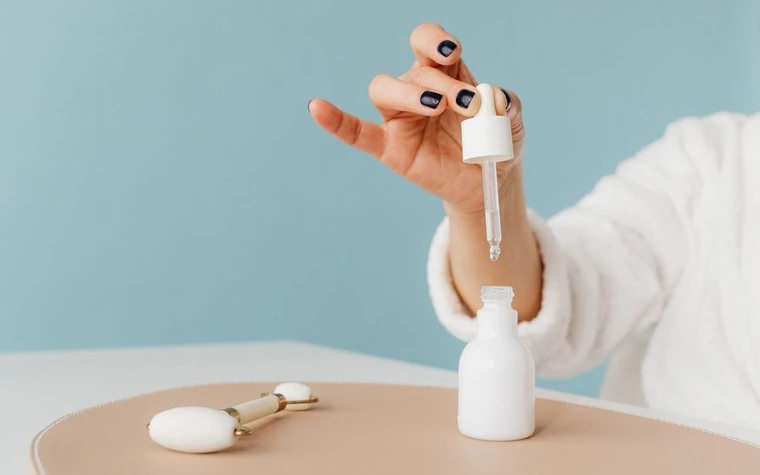
So the honest reason to pause between steps is not penetration. It is film integrity: applying a heavy product onto a surface that is still fluid tends to move the first layer around rather than sit on top of it, which is how you end up with pilling. That is a texture problem with a texture solution, and the length of the pause is however long it takes for the surface to stop being slippery. For most products that is well under a minute.
Where a pause has a defensible reason
There is one category where sequence genuinely changes chemistry rather than feel: formulas that only behave as intended within a narrow pH band. Low-pH vitamin C formulations are the standard example, and the reasoning is set out in the vitamin C piece. Laying a much higher-pH product straight on top can shift the pH of the film before the first product has settled into it.
Even here, "wait" is a proxy for the real instruction, which is ordering: put the pH-sensitive product on skin that has nothing on it, let the surface dry rather than counting seconds, then continue. The full ordering logic — and which parts of it survive scrutiny — is in the layering order piece. A stopwatch adds nothing that drying does not already tell you.
The clock that actually deserves tracking
If you are going to time one thing, time reapplication rather than the gaps between steps. The same regulation prescribes that text too. For a product that passes the water resistance test, 21 CFR 201.327(e)(3) requires the label to say: reapply after 40 minutes or after 80 minutes of swimming or sweating — whichever the product's test supports — immediately after towel drying, and at least every 2 hours. For a product that does not pass that test, paragraph (e)(4) requires: reapply at least every 2 hours, and use a water resistant sunscreen if swimming or sweating.
Note what the water resistance claim is: a tested duration, 40 or 80 minutes, not a property. Paragraph (g) of the same section makes the point explicitly by naming claims that are false or misleading on a sunscreen — "sunblock," "sweatproof" and "waterproof." A product carrying those words is misbranded, which is a useful thing to know when reading marketing copy about filters, including the newer ones discussed in the piece on bemotrizinol.
What this means for an actual routine
- Between steps: pause until the surface is no longer slippery. Seconds, usually. Longer if the product is genuinely wet, and that is a texture judgement rather than a rule.
- pH-sensitive products: put them on bare skin and let them dry before continuing.
- Sunscreen: last step, then fifteen minutes of doing anything indoors before sun exposure.
- Outdoors: every two hours, and after 40 or 80 minutes of water or sweat depending on what the label claims, and immediately after towelling.
- Everything else: if a wait time has no stated mechanism, it does not have one.

Why the folklore is so specific
Precise numbers feel authoritative, which is exactly why unfounded ones spread. "Wait sixty seconds" sounds like it came from somewhere; "wait until it stops feeling wet" sounds like someone guessing, even though it is the more defensible instruction. The regulation is a useful corrective here precisely because it is narrow. It fixes one interval, states the test that produced it, and says nothing at all about the gaps between serums — which is a reasonable indication of how much there is to say about them.
The routine that follows from this is shorter than the one in the videos, and the time you were spending on timers is better spent on applying enough sunscreen in the first place. The 2 mg/cm² in the test method is a much larger quantity than most people use, and no waiting interval compensates for under-application.
Sources and date: 21 CFR 201.327, over-the-counter sunscreen drug products — paragraph (e)(1)(ii) for the "15 minutes before sun exposure" directions text; paragraph (i) for the SPF test method, including application at 2 mg/cm² and the paragraph (i)(4)(iv) waiting period of at least 15 minutes before UV exposure; paragraphs (e)(3) and (e)(4) for reapplication after 40 or 80 minutes of swimming or sweating, immediately after towel drying, and at least every 2 hours; and paragraph (g) for the prohibited claims "sunblock," "sweatproof" and "waterproof." Verified August 2026 against the current eCFR text. Labelling rules described here apply to the United States and differ in other markets. Patch test any new product on a small area before applying it to the whole face, and take persistent irritation or a diagnosed skin condition to a dermatologist rather than to a change in routine — this article is general information and not medical advice.
All content is fact-checked under our editorial standards.