
Witch Hazel in Skincare, Explained: What the FDA Monograph Allows It to Claim, the 14-15% Alcohol in a Distillate, and What Two UV-Erythema Trials Measured
Witch hazel is one of the oldest toner ingredients on the shelf, and one of the few botanicals that appears in both a US federal drug monograph and a European herbal assessment. That makes it unusually easy to check against primary documents. This article walks through what the FDA's over-the-counter rules say about witch hazel, what the 14-15% alcohol in a typical distillate is doing there, what two UV-erythema studies on a 10% distillate measured, and what European regulators concluded about the strength of the evidence. It summarizes published sources and does not tell you what your skin will do.
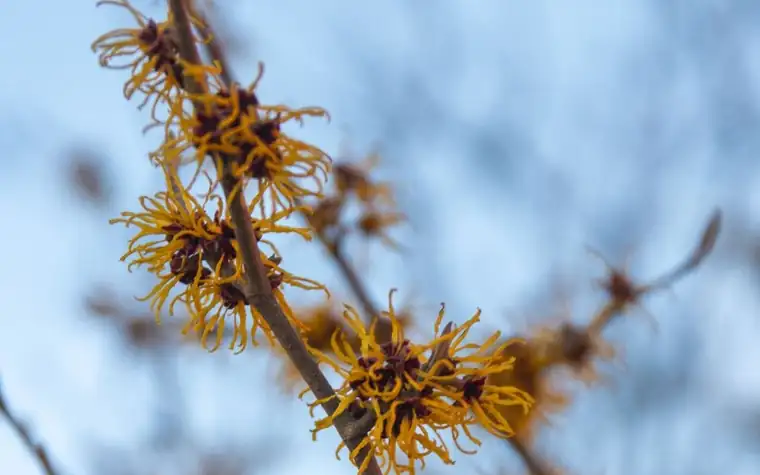
What "witch hazel" means on a label
The word covers more than one thing. The plant is Hamamelis virginiana, and the toner-aisle product is usually a steam distillate of its twigs, not the tannin-rich bark extract used in some herbal preparations. The European Medicines Agency's 2009 assessment report lists the distillate preparations separately from the bark and leaf, and describes a distillate prepared from dried twigs with ethanol at 14-15%, and another from leaf and bark with ethanol at 6%. On a cosmetic label the ingredient normally appears under its botanical name, Hamamelis virginiana (witch hazel) water or extract, and the label rarely tells you which of these preparations, or how much alcohol, you are getting.
What the FDA monograph actually lists
In US federal regulations, witch hazel is named in 21 CFR 347.12(c) among the astringent active ingredients for over-the-counter skin protectant drug products. Unlike its neighbors on the list, the regulation text gives no percentage for it: aluminum acetate is listed at 0.13 to 0.5 percent and aluminum sulfate at 46 to 63 percent, but witch hazel is simply named. The permitted claim is narrow. The monograph's labeling section allows "Relieves minor skin irritations due to" insect bites, minor cuts or minor scrapes, with directions to apply as often as needed. It also requires "For external use only," a warning to avoid contact with the eyes, and a line telling users to stop and ask a doctor if the condition worsens or symptoms last more than 7 days. Nothing in those lines is about pores, oil or acne.
The 14-15% alcohol question
The European report describes widely used distillates with 14-15% alcohol in water and a small amount of witch hazel essential oil, and notes that such diluted distillates have virtually no tannin content. That detail matters because tannins are the astringent compounds people usually credit. The same report puts tannins at 8-12% in the bark itself, so a bark preparation and a bottled distillate are not interchangeable. If you want the general picture of how ethanol behaves in leave-on products, our article on alcohol denat and its drying reputation covers what the safety review concluded. For witch hazel specifically, whether the alcohol or the plant is responsible for a tightening or stinging feeling is not something the sources separate.
Trial one: a 10% distillate lotion after UVB
A 1998 study in Dermatology tested an aftersun lotion with 10% hamamelis distillate against its vehicle and a previous aftersun formulation in 30 healthy volunteers, using a modified UVB erythema test with doses from 1 to 2 minimal erythema doses. Test fields on the back were treated under occlusion for 48 hours. The authors reported erythema suppression of roughly 20% at 7 hours and 27% at 48 hours in the hamamelis fields, against 11-15% in the fields treated with the other lotions, and called the data evidence of an anti-inflammatory action. Two limits are worth keeping in mind. This was a sunburn model, not a toner used on healthy skin, and the comparison was against other lotions rather than against nothing at all.
Trial two: three distillates, two vehicles and hydrocortisone
A 2002 follow-up in Skin Pharmacology and Applied Skin Physiology used 40 volunteers and tested three lotions with 10% distillate from different suppliers, two vehicles, an antihistamine gel, and hydrocortisone 1% cream and 0.25% lotion. The hydrocortisone products were the most effective. All three witch hazel lotions showed an anti-inflammatory effect, but so did the vehicles, and only one of the three beat the vehicle significantly, at the 1.4 dose level. The antihistamine gel did not outperform the witch hazel lotions or the vehicles. The authors concluded that differences between the distillates were slight, though it was possible to choose the best one for aftersun use. The honest reading is a modest, inconsistent signal that depends on the supplier and on what the lotion base is doing on its own.
What European regulators concluded
The 2009 EMA assessment summarizes the field plainly: consistent scientific data supporting the efficacy of hamamelis preparations are still limited, some controlled trials gave positive outcomes of weak statistical interpretation, and the beneficial effect is primarily supported by traditional use. On that basis the distillate has a traditional-use indication for relief of minor skin inflammation and dryness of the skin, which is a lower evidentiary tier than an established-use claim. That is a measured position, and it is more cautious than most toner marketing.
Sensitization and irritation
The same report calls external use safe at recommended doses and says contact allergic dermatitis has been reported only in rare cases. It cites a study by Bruynzeel and colleagues in which 1,032 patients were tested with five popular ointments; the ointments produced positive reactions in 11 patients, and four of them reacted to an ointment containing 25% hamamelis extract. Rare is not never, and the alcohol in a distillate can irritate on its own, particularly on skin that is already stressed. For comparison with another botanical where the allergen question is better mapped, see our explainer on tea tree oil and oxidation. For a different ingredient that also has a regulatory range behind its soothing claim, see allantoin.
How to read a witch hazel product
Check whether the ingredient list shows an alcohol, and where it sits. Check whether the product is a distillate or an extract. Treat any claim about pores, oil control or acne as outside what the cited regulations and trials addressed. The FDA claim is about minor irritations from bites, cuts and scrapes, and the EMA claim is about minor inflammation and dryness, which is not a description of a daily toner for oily skin.
This article summarizes published regulatory documents and studies and is not medical advice. Patch test any new product first, following our guide to patch testing a new skincare product, and consult a dermatologist if your skin reacts, breaks out repeatedly, or does not improve.
All content is fact-checked under our editorial standards.