
Adenosine, Explained: What the 126-Woman FOITS Trial Actually Measured
Read the ingredient list on Korean anti-ageing creams and one name keeps appearing near the bottom, in the trace-level zone: adenosine. It is not marketed the way retinol or vitamin C are marketed. There is no percentage on the front of the jar, no warnings about sun sensitivity, no purge phase. It sits quietly in formulas from cushion compacts to sheet masks, and most people who use it every day could not say what it does. The reason it is there is partly regulatory and partly evidentiary, and both halves are worth understanding before you decide whether it belongs in your routine.

What adenosine actually is
Adenosine is not a botanical extract or a synthesised cosmetic molecule invented for skincare. It is a purine nucleoside — one of the fundamental building blocks of nucleic acids, and a signalling molecule the body already uses everywhere. It is the "A" in ATP, the cell's energy currency. In clinical medicine it is a well-known compound with an entirely different use; in cosmetics it is used topically at very low concentrations for a completely separate purpose. That familiarity is part of the appeal to formulators: the molecule is small, water-soluble, stable across a wide pH range, and has a long history of use.
The proposed mechanism in skin is receptor signalling. Adenosine binds adenosine receptors — the A2A subtype is the one usually named — present on dermal fibroblasts, and the hypothesis is that this signalling influences fibroblast behaviour and matrix protein production. It is worth being precise about the status of that claim: it is a proposed mechanism supported by cell-level work, not a settled account of what happens in intact human skin after you smooth on a cream. The clinical evidence, discussed below, is about measured outcomes rather than mechanism.
Why Korean formulas are full of it
The main reason you see adenosine everywhere in K-beauty is structural. Korea operates a functional cosmetics system, in which certain claims — including wrinkle improvement — are a regulated category rather than marketing language. Korea's Ministry of Food and Drug Safety maintains notices that set out which actives may support those claims and at what levels, and the companion standards document, Standards and Test Methods for Functional Cosmetics, contains monographs written specifically for adenosine preparations: adenosine cream and adenosine-impregnated mask each have their own test method, as do combination preparations such as niacinamide–adenosine solutions and lotions.
That last detail explains a pattern you may have noticed on labels. Niacinamide and adenosine appear together constantly in Korean products, and it is not a coincidence of trend — it is a recognised combination with its own analytical standard, pairing a whitening-category active with a wrinkle-category one. If you already know what niacinamide was measured to do at 2%, 5% and 10%, the pairing makes structural sense: two actives with different regulatory categories and no meaningful formulation conflict.
The 2006 trial, in its own numbers
The study most often cited for adenosine is Abella, published in the International Journal of Cosmetic Science in 2006 (volume 28, issue 6, pages 447–451). It is worth reading the design rather than the headline, because the design is better than most cosmetic trials.
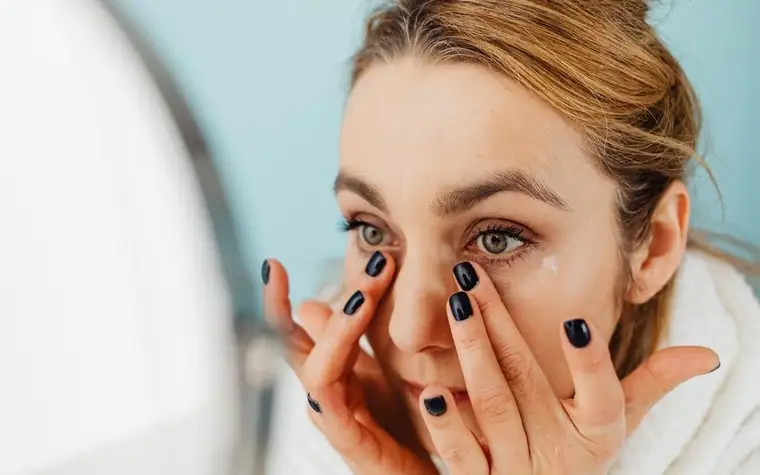
It was a blind, randomised, placebo-controlled study. 126 female volunteers between 45 and 65 met the inclusion criteria for periorbital lines. Each was given two of three products — a cream containing adenosine, a dissolvable film containing adenosine, or a placebo — and applied them to the periorbital area on each side of the face, producing 84 subjects per product. Both adenosine-containing products produced significant improvements in skin smoothness around the eyes, detectable after three weeks of application on the Ra and Rz parameters measured by the FOITS technique, and steadily confirmed after two months. The cream also significantly improved glabellar frowns — the vertical lines between the brows.
What Ra and Rz are, and what they are not
FOITS stands for fast optical in-vivo topometry of human skin. In plain terms, a silicone replica or optical scan of a skin area is measured for surface roughness, and the results are reported as roughness parameters borrowed from engineering metrology. Ra is the arithmetic average deviation of the surface profile; Rz is an average of the largest peak-to-valley heights. Lower numbers mean a flatter surface.
This is a genuine instrumental measurement, and that is its strength — it does not depend on a panelist deciding whether she looks better today. But it measures surface topography, which is a narrower thing than "younger skin". A surface can flatten because the tissue changed or because it is better hydrated and swollen at the moment of measurement. Well-run studies control for this with acclimatisation and standardised conditions, and the two-month confirmation in the Abella data makes a purely transient effect less likely. Still, when you see "clinically proven to reduce wrinkles," what was usually proven is a change in Ra and Rz on a small facial area over weeks.
The concentration question
Adenosine is used at concentrations far below the ones you are used to seeing on retinol or vitamin C labels — hundredths of a percent rather than whole numbers. The level associated with Korea's wrinkle-improvement category is commonly cited as 0.04%, and Korean functional products are generally formulated around that figure rather than competing to go higher. Because these values are set by notice and revised periodically, treat any number you read — including that one — as something to confirm against the current MFDS notice rather than as a permanent fact.
The more useful takeaway is directional: with adenosine, more is not the axis of competition. This is the opposite of the situation with vitamin A, where the EU set a 0.3% ceiling on retinol in leave-on products precisely because concentration was escalating. If a brand cannot tell you the adenosine level, that is unremarkable; if a brand implies that its adenosine content is dramatically higher than everyone else's, that is a claim worth questioning.
Why it is easy to place in a routine
Adenosine is unusually undemanding. It has no pH window to protect, unlike L-ascorbic acid, which needs an acidic formula to remain stable. It is not photolabile in the way that shapes retinoid instructions, so evening-only use is not required by the chemistry. It has no widely reported conflict list, which is why it turns up alongside peptides, niacinamide and humectants without special sequencing advice.
In practice that means adenosine is a property of the product you chose rather than a step you add. Follow the ordinary thin-to-thick layering logic and it will be fine. There is no version of this ingredient that requires you to buffer, alternate nights, or build tolerance.
What adenosine does not do
Being clear about limits is more useful than another list of benefits. The evidence base is about fine surface lines measured over weeks — periorbital lines and glabellar frowns in the study above. Nothing in it speaks to deep structural folds, to volume loss, or to laxity, which are different problems with different tools. It is not an exfoliant and will not change texture that comes from dead cell buildup. It is not a barrier ingredient, so if your skin is stinging and flaking, adenosine is not the answer to that; barrier lipids are a separate conversation. And it is not sun protection — no topical wrinkle active substitutes for sunscreen, which remains the intervention with the strongest evidence behind it for photoageing.
How to read the label
Three practical checks. First, note where adenosine sits in the list: at 0.04% it will be near the end, typically after the preservative, and that is expected rather than a red flag. Second, look at what surrounds it — adenosine is a supporting active, and a formula whose only interesting ingredient is adenosine is not doing much. Third, if the product is a Korean functional cosmetic, the packaging will say so; that designation tells you the claim category was reviewed, not that the product will outperform anything else in it. Give any new product several weeks before judging it, since the trial data itself needed three weeks to show a measurable difference.
Patch-test any new product on a small area before applying it to the face, and see a dermatologist for any persistent or worsening skin concern — this article is general information about ingredients and regulation, not a diagnosis or treatment recommendation.
All content is fact-checked under our editorial standards.