
Glass Skin, Decoded: What Actually Changes the Way Your Skin Reflects Light
"Glass skin" describes an optical result, not a skin condition. The phrase points at a surface that reflects light in one clean direction instead of scattering it — the way a polished pane does. That is a useful thing to understand, because it means the look is produced by surface physics, and surface physics has a short and specific list of inputs. Most of what gets sold under the label targets none of them. Worse, one reliable way to produce the appearance is to thin the skin, which is a bad trade dressed up as a result.

Specular and diffuse: the whole idea in one distinction
Light hitting skin does one of two things. Some of it bounces off the outermost surface at a single angle — specular reflection, which reads as shine or gloss. The rest enters the tissue, scatters among cells and pigment, and comes back out in every direction — diffuse reflection, which reads as colour and softness.
A rough surface breaks specular reflection into a thousand small angles, and the eye reads that as matte, textured, dull. A smooth surface returns it coherently, and the eye reads that as luminous. Research on skin surface microstructure and reflection has approached exactly this using geometric optics: the fine relief of the skin surface determines how much of the light comes back in one direction.
So the entire question becomes: what makes the outer surface smoother at the scale of a few micrometres? There are three honest answers, and they are all boring.
Answer one: water in the stratum corneum
The outermost layer is built from flattened corneocytes held in a lipid matrix. When that layer takes on water, the corneocytes swell, the microscopic relief between them flattens, and the surface becomes measurably more even. This is the mechanism behind the observation, familiar to anyone who has stepped out of a shower, that skin looks better wet — and the reason moisturiser produces visible change within minutes, long before anything biological could have happened.
The ingredients that do this are humectants, and the workhorses are unglamorous: glycerin, which has more supporting literature behind it than anything else in the category; hyaluronic acid and its salts; panthenol; urea; butylene glycol and propanediol, which appear high in ingredient lists and are doing real work while reading as filler. Sugars, amino acids and sodium PCA belong here too.
The catch is that humectants pull water and then hand it to the air. On their own, in dry conditions, that can leave you worse off than before. Which brings up the second input.
Answer two: lipids that keep the water there
Water held in the stratum corneum leaves through the surface continuously; the rate is measured as transepidermal water loss. A functioning lipid matrix slows that rate, and the matrix is built from three families in roughly comparable proportions: ceramides, cholesterol and free fatty acids. Formulations aiming at barrier repair are frequently built around a ratio in that region — a 3:1:1 balance appears repeatedly in the dermatology literature on barrier restoration.
Above them sit occlusives, which are cruder and very effective: petrolatum, dimethicone, squalane, plant butters. They do not repair anything. They sit on top and slow evaporation, which buys the humectant layer beneath them time to matter.
The practical version is that a humectant without something above it is half a step. This is one of the reasons product order is not arbitrary — the logic is set out in what layering order is actually doing.
Answer three: a controlled amount of desquamation
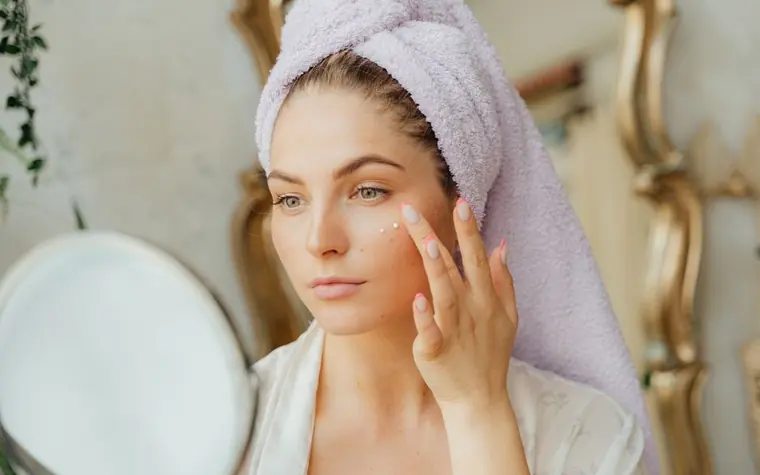
Corneocytes are shed continuously. When shedding slows — with age, in cold dry weather, in some skin types — cells pile up unevenly and the surface roughens. Gentle chemical exfoliation with a hydroxy acid, or a retinoid used at a tolerated frequency, evens that out and the surface returns light more coherently.
This is also where the whole idea goes wrong most often, and it goes wrong in a way that mimics success. Over-exfoliation produces a smoother, shinier, more translucent surface — and a compromised barrier. Elevated water loss, sensitivity, stinging on application and a look that reads as glassy in the mirror and tight to the touch. The appearance and the damage arrive together, which is precisely why "it's working" is an unreliable read in the first fortnight.
The concentration and vehicle matter more than frequency here, and tolerance is individual. Reducing frequency and reassessing after two weeks is the standard, unexciting correction.
What contributes less than the marketing suggests
Some steps are widely credited and are doing something narrower than claimed.
- Ten-step routines. The number is not the mechanism. Three products that hydrate, seal and protect will out-perform ten that all hydrate.
- Sheet masks. Genuinely effective for a few hours — occlusion plus a humectant load. That is a real, temporary, optical effect, not a change in the skin.
- "Pore-minimising" claims. Pore size is largely structural. Products can reduce the visibility of pores by smoothing the surrounding surface; they do not resize them.
- Brightening actives. Ingredients such as niacinamide act on pigment and on barrier function. Those are worthwhile, and they are a separate axis from surface reflectance.
None of that makes these products useless. It makes them mis-filed. If the target is how light leaves the surface, the levers are water, lipids and even shedding — in that order.
Two things nobody markets as glass skin
The first is sunscreen. Cumulative UV exposure degrades the dermal support that keeps the surface even, and no topical routine outruns daily unprotected exposure. It is the least interesting recommendation in skincare and still the one with the most evidence attached.
The second is knowing which shortage you have. Skin low in water and skin low in lipids look similar and respond to different formulas; a humectant serum on a lipid-depleted face is a lot of effort aimed at the wrong problem. The distinction is worked through in dry versus dehydrated skin.
A reasonable version of the routine
- Cleanse without stripping — if skin feels tight afterwards, the cleanser is too aggressive for the goal.
- Apply a humectant to slightly damp skin.
- Follow with a lipid-containing moisturiser, and an occlusive on top in dry conditions or overnight.
- Exfoliate at the lowest frequency that keeps texture even, and stop entirely at the first sign of stinging or tightness.
- Use sunscreen daily.
- Accept that some of the look is anatomy — sebum output, pore density and skin thickness vary between people and are not products.
The honest summary is that glass skin is a well-hydrated, intact barrier photographed in flattering light. Half of that is achievable with three products. The other half is lighting, and there is no serum for lighting. Related surface-and-shadow effects around the eye are covered in the four types of dark circles.
Written with reference to published work on skin surface microstructure and reflection, on stratum corneum hydration and transepidermal water loss, and on ceramide–cholesterol–fatty acid barrier formulation, as of August 2026. "Glass skin" is a descriptive term used in beauty writing, not a clinical or dermatological category. Patch-test any new product on a small area before applying it to the face, and take persistent irritation, redness or a skin concern that is not settling to a dermatologist rather than to a routine change. Nothing here is a treatment recommendation.
All content is fact-checked under our editorial standards.