
Dark Circles Are Not One Problem: The Four Types, and What Topicals Can Actually Reach
"Dark circles" is a single phrase covering at least three unrelated physical situations. One is pigment sitting in the skin. One is blood vessels showing through skin that is thin to begin with. One is not colour at all — it is a shadow cast by the shape of the face. They look similar in a bathroom mirror and they respond to completely different things, which is why a brightening serum can be used faithfully for four months with no visible change. Before buying anything, it is worth working out which of them you are looking at.

Dermatology sorts them into four types
The classification used in the clinical literature — set out by Roh and Chung in Dermatologic Surgery in 2009 and used in reviews since — divides infraorbital dark circles by clinical appearance:
- Pigmented (P) — a brown hue under the eye from melanin held in the epidermis or dermis.
- Vascular (V) — a blue, pink, or purple hue from superficial vessels visible through thin skin, sometimes with puffiness.
- Structural (S) — skin-coloured. The darkness is shadow, produced by the tear trough, volume loss, or a prominent orbital rim.
- Mixed (M) — two or three of the above at once. This is common, and it is why partial improvement is a realistic outcome rather than a disappointing one.
The reason this matters commercially is blunt: the entire depigmenting category — the tyrosinase inhibitors, the antioxidants, the acids — is aimed at one of those four. If your circles are vascular or structural, no amount of a well-formulated brightening product is addressing the mechanism.
Two checks you can do at a mirror
Clinicians use a stretch test and, for pigment, a Wood's lamp. The first translates well to a bathroom.
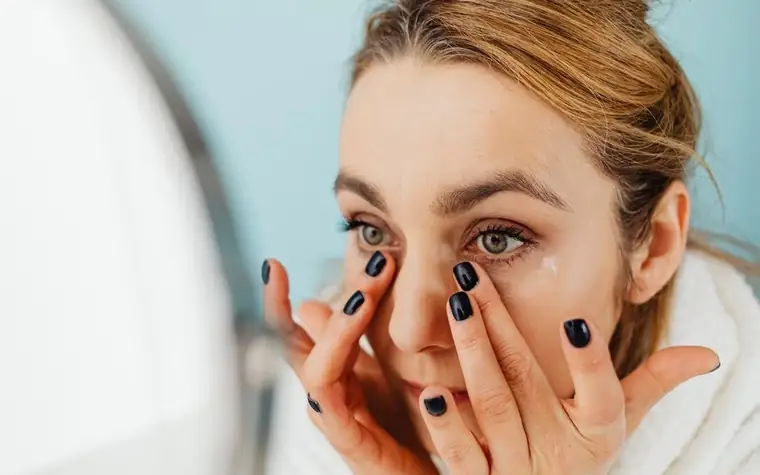
The stretch test. Gently stretch the skin of the lower lid sideways with a fingertip and watch what happens to the darkness. If the colour stays, there is pigment in the skin. If it lightens or disappears, you are looking at a shadow — the structural type. Under stretch, a vascular component often becomes more visible rather than less, because the skin thins further.
The lighting test. Look at your under-eye in flat, even light — outdoors on an overcast day, or facing a window — and then under a downward ceiling light. Structural darkness changes dramatically between the two; pigment barely changes at all. If your circles look severe at the office and mild in a selfie by a window, that is a shadow.
Colour is the third clue and the least reliable one. Brown suggests pigment, blue-purple suggests vasculature, but the mixed type blurs it, and deeper skin tones can carry vascular darkness that reads as brown.
Pigmented type — what has actually been measured
This is the only type with a substantial topical literature, and even there the results are modest and slow.
Hydroquinone at 2–6% is the reference tyrosinase inhibitor, and reviews of periorbital hyperpigmentation note that the effect of treatment "generally becomes evident after five to seven months of therapy." That timeline is worth sitting with — it is the benchmark against which every gentler ingredient should be judged. Hydroquinone is prescription-only in many markets and is associated with irritation and, with prolonged use, exogenous ochronosis, so it belongs in a dermatologist's hands rather than a routine you assemble yourself.
Topical vitamin C has one frequently cited periorbital study: a 10% lotion used for six months produced visible lightening, but the authors attributed it to an increase in dermal thickness concealing the discolouration rather than to pigment removal — no significant change in melanin index was detected. That is a genuinely interesting result, because it means the mechanism was thickening rather than bleaching.
Kojic acid (typically 1–4%) and arbutin (studied around 3%) are tyrosinase inhibitors with melasma data behind them and little periorbital-specific evidence; they are used by extension. Azelaic acid is noted in reviews as carrying neither the leukoderma nor the ochronosis risk of hydroquinone and as being suitable for prolonged use, which makes it a reasonable long-term option for post-inflammatory pigment. Retinoids appear mainly as a partner ingredient that speeds the shedding of pigmented cells — and the eyelid is the thinnest skin on the body, so irritation is the limiting factor, not potency.
Vascular type — why brightening ingredients miss
Here the colour is coming from blood in vessels sitting close to a translucent surface. There is no melanin to inhibit. Anything marketed as reducing the appearance of this type is working by one of two indirect routes: making the overlying skin less transparent, or temporarily reducing puffiness that deepens the effect.
Ingredients that thicken or better hydrate the skin fall in the first group, which is where the vitamin C result above becomes relevant — concealment by dermal thickening is a real, if slow, cosmetic mechanism. Caffeine, widely used in eye formulas, is generally positioned as a temporary de-puffing agent rather than a treatment for the vessels themselves; the periorbital review literature does not establish it as a depigmenting agent.
Two practical points do more than most products. Sleep position and fluid retention visibly change morning puffiness. And allergic eye rubbing is a genuine driver — chronic rubbing and inflammation produce post-inflammatory pigment on top of the vascular appearance, converting a one-mechanism problem into a mixed one. If your eyes itch seasonally, addressing that with a physician does more for the under-eye than any serum will.
Structural type — the one topicals cannot reach
If the stretch test cleared the darkness, the topical aisle has nothing for you, and reviews say so plainly: depigmenting agents do not address shadows produced by anatomy, which require physical intervention. The tear trough is a ligamentous attachment; volume loss and skin laxity with age deepen it. No cream reshapes that.
This is not a counsel of despair — it is a reason to stop spending. The honest options for the structural type are cosmetic (light and colour, below), and clinical procedures discussed with a dermatologist or an oculoplastic specialist. That conversation belongs with a qualified practitioner who can examine the area, not with a product page.
Colour correction is a legitimate answer, not a consolation prize
Concealer gets treated as the thing you do while waiting for skincare to work. For vascular and structural circles it is frequently the most effective available option, and it works on optics rather than biology.
The principle is complementary colour. Blue-purple vascular darkness is neutralised by a peach or salmon tone; brown pigment is better addressed by a slightly lighter version of your own shade rather than by a corrector. Structural shadow responds to light reflection — a product with subtle light-diffusing particles applied to the deepest part of the trough, not across the whole lid. Applied thickly to a shadow, an opaque concealer often reads as a grey patch, because you have lightened a surface without removing the shadow that created it.
Whatever sits under the eye should be layered with the same logic as the rest of the routine: thinner textures before thicker ones, and hydration underneath so a product does not settle into fine lines. The ordering principles in how skincare layering order works apply to the eye area unchanged.
What to change first, before buying anything
- Run the stretch test. It costs nothing and it rules out the largest category of wasted spending.
- Use sunscreen on the orbital area. UV drives melanogenesis, and the under-eye is routinely missed at application.
- Stop rubbing. Investigate the itch instead. Post-inflammatory pigment is one of the documented causes.
- Hydrate and support the barrier. Thin, dehydrated skin is more translucent and shows both vessels and shadow more; the distinction between lipid and water deficit is covered in dry versus dehydrated skin.
- If you use an active, give it a real trial. The clinical benchmark for the pigmented type is months, not weeks. Judging a product at three weeks tells you nothing.
- Introduce one thing at a time. The eyelid is the thinnest skin on the body; a well-tolerated ingredient elsewhere can sting here. Gentle actives such as niacinamide are commonly used around the eye for that reason.
When to stop self-treating
Some under-eye darkening is not cosmetic. Sudden onset, darkening on one side only, associated swelling, pain, vision changes, or a change that follows starting a new medication are all reasons to see a physician rather than to shop. Reviews of periorbital hyperpigmentation note that certain ophthalmic medications can darken the periorbital area, and that some pigmented lesions in this region are dermal melanocytic conditions requiring diagnosis rather than a routine.
Persistent darkening in a young person with no family history, or circles that worsen steadily despite good sleep and sun protection, also warrant a professional look. A dermatologist can distinguish epidermal from dermal pigment in a way that a mirror cannot, and that distinction determines whether topical treatment has any chance of working at all.

Classification and study details above are drawn from published dermatology literature: Roh MR and Chung KY, "Infraorbital dark circles: definition, causes, and treatment options," Dermatologic Surgery (2009); review articles on periorbital hyperpigmentation including the comprehensive review in The Journal of Clinical and Aesthetic Dermatology; and the Ohshima et al. study of 10% topical vitamin C over six months. Findings in controlled studies describe group averages and are not a promise for any individual, and cosmetic products are not treatments for a medical condition. Patch-test any new product on a small area before applying it near the eye, and consult a dermatologist for persistent, asymmetric, or worsening under-eye changes.
All content is fact-checked under our editorial standards.