
Sensitive Skin, Explained: What the Lactic Acid Sting Test Actually Measures
"Sensitive skin" is the most-claimed category in skincare and the least defined one. Dry skin can be measured by water loss, oily skin by sebum output — but sensitive skin has no lesion, no rash and often nothing at all to photograph. What it has instead is a sensation, and an industry test built specifically to provoke it. Understanding that test explains why some products sting on you and not on a friend, why a stinging product is not automatically damaging you, and what a "suitable for sensitive skin" claim is actually based on.

It is a reported syndrome, not a measured skin type
Start with how common the report is. A 2019 review in Frontiers in Medicine pooled surveys from more than twenty countries across five continents and found that roughly 60–70% of women and 50–60% of men report some degree of sensitive skin. Restricted to people rating themselves moderately or very sensitive, the figure is about 46%, with individual studies ranging from 7% to over 70%.
That spread is the interesting part. A European survey of 4,506 people found 74.7% reporting any sensitivity and 38.1% moderate or very sensitive; a Chinese survey of 408 women found 23% and 7%. A French study of 5,000 reported 66% of women and 51.9% of men; a Brazilian study of 1,022 reported 80.4% and 53.06%. When a trait varies from 7% to 80% depending on who is asked, you are not measuring a fixed biological type — you are measuring self-report, filtered through language and expectation.
The 2017 expert definition, and the clause that does the work
The Special Interest Group on Sensitive Skin of the International Forum for the Study of Itch settled a definition by Delphi consensus: a syndrome defined by the occurrence of unpleasant sensations — stinging, burning, pain, pruritus and tingling — in response to stimuli that normally should not provoke such sensations.
Two things are doing the work there. First, the response is defined against a normal baseline: the trigger is something that should not hurt. Second, the definition explicitly separates the syndrome from visible disease, because those sensations cannot be explained by lesions attributable to a skin disease. If there is a rash, a flare or persistent redness with a pattern, that is a dermatological question rather than a cosmetic one, and it belongs with a dermatologist rather than a new serum.
What the lactic acid sting test does
The industry's standard provocation is the lactic acid sting test, developed by Frosch and Kligman in 1977. The original protocol is oddly physical for a cosmetic test: sweating is induced for 15 minutes in a chamber at about 120°F, then 5% lactic acid is applied with a soaked cotton swab, rubbed briskly over the nasolabial fold and cheek.
The subject then reports stinging at 2.5, 5.0 and 8.0 minutes on a 0-to-3 scale, and the mean of those three readings is the score. That is the whole measurement. Notice what it does not record: no redness reading, no barrier measurement, no photograph. It scores a sensation on a timeline, because the sensation is the phenomenon.
The nasolabial fold is not an arbitrary site. It is chosen because response there is reliably stronger, which is also why your own skin may tolerate an acid on the cheek and object to it beside the nose.
Why a 10% version exists
A later variant raised the concentration to 10% lactic acid so the sweat-induction step could be dropped. That is a practical change, not a cosmetic one: heating and sweating a panel before every test is slow, so a stronger stimulus buys a simpler protocol.
It also matters when you read a claim. "Passed a sting test" does not specify which protocol, which concentration, which site or which scoring window, and those choices change how many people sting. A test result is only as strict as the version used.
Stinging and irritation are not the same event
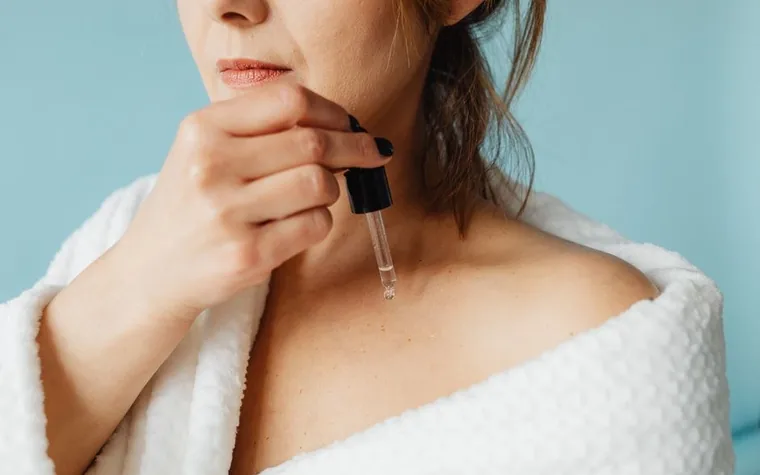
This is the practical distinction to carry around. Irritant contact reactions are visible: redness, scaling, swelling, and they develop over hours. Stinging is immediate, subjective and often invisible, which is exactly why the sting test asks the subject rather than the instrument.
So a product that stings for thirty seconds and leaves no mark has told you something real about your sensory threshold, but it has not proven that your barrier was damaged. Conversely, a product that never stings can still be quietly compromising your barrier over weeks. The two signals need to be read separately — and if your skin has been feeling tight, flaky and reactive together, the more useful lens is barrier repair rather than sensitivity as such.
Which ingredients tend to show up as stingers
The category is defined by mechanism, not by whether an ingredient is "harsh". Low-pH actives are the obvious group: alpha hydroxy acids such as lactic and glycolic acid, and L-ascorbic acid, which needs a pH below about 3.5 to be stable and absorbed — the same condition that makes it sting on reactive skin. That trade-off is covered in the vitamin C entry.
Beyond acids, the usual suspects on stinging panels are ethanol at high inclusion, propylene glycol, fragrance and essential oils, cooling agents such as menthol, and preservatives in the benzoate and sorbate family. Retinoids belong in a slightly different bucket — their discomfort typically builds over days of use rather than arriving in the first minute, which is why concentration and frequency matter more there, as the EU retinol limits illustrate.
What a "sensitive skin" claim on a label rests on
Claims of this type are usually substantiated on a recruited panel of self-identified sensitive-skin subjects, sometimes screened with a sting test first. That is a reasonable method, and it is also a narrow one. The panel was not you, the vehicle tested was the finished formula rather than the active alone, and the endpoint was tolerance over a defined window rather than long-term performance.
Which means the claim is best read as "this formula did not provoke a defined panel under defined conditions" — useful, but not a guarantee, and not a reason to skip your own test. The same caution applies in reverse: an unlabelled product is not thereby unsuitable.
Running the same logic at home
You can borrow the structure of the test without the chamber. Apply the product to a small area — the inner forearm first, then beside the nose if the forearm passes, since that is where response is strongest — and note what you feel at roughly the same intervals the protocol uses: immediately, at five minutes and at ten. Then look at the same spot the next day for anything visible.
Separate the two readings, because they answer different questions. Sensation at minute one tells you about tolerance; redness or flaking at hour 24 tells you about irritation. Introduce one new product at a time, or neither reading means anything. And if you are trying to work out whether the underlying issue is a shortage of water or of lipids, the dry versus dehydrated distinction is the better place to start than the sensitive-skin aisle.
Patch-test any new product on a small area before applying it to the face, and see a dermatologist for persistent stinging, burning or any visible, worsening skin concern — this article is general information about how sensitivity is defined and measured, not a diagnosis or treatment recommendation.
All content is fact-checked under our editorial standards.