
Skin Barrier Repair, Explained: What the 1996 Lipid Study Actually Found
"Barrier damage" has become the explanation of choice for anything that goes wrong with skin, and the proposed fix is usually a product with ceramides on the front of the box. Both halves of that are half right. The barrier is a specific structure with a measurable function, damage to it has a specific signature, and the research on repairing it says something more precise — and more restrictive — than "use ceramides." What that research actually found is worth knowing, because it changes which product on the shelf is likely to do anything.

What the barrier physically is
The permeability barrier lives in the stratum corneum, the outermost layer. The standard description is bricks and mortar: flattened, protein-filled corneocytes are the bricks, and the mortar is a set of lipids organised into ordered lamellar sheets between them.
That mortar is not one substance. It is three classes of lipid working together — ceramides, cholesterol and free fatty acids. Ceramides make up roughly half of the intercellular lipid by mass, which is why they get the marketing attention, but the organisation depends on all three being present in workable proportions. The lamellae are what limit how fast water leaves the skin.
The measurement that defines "damaged"
Barrier function is not a feeling. It is measured as transepidermal water loss (TEWL) — the rate at which water diffuses out through the skin. A functioning barrier keeps TEWL low. When the lipid lamellae are disorganised or depleted, TEWL rises, and it stays elevated until the structure is rebuilt.
This matters because it separates two things people conflate. Skin can feel dry because it lacks water at the surface while the barrier is intact, or it can be losing water faster than it can replace it because the barrier is not doing its job. Those need different responses. The distinction is worked through in dry skin versus dehydrated skin.
The signature of a disrupted barrier
There is a recognisable pattern, and the most telling item is the first one.
- Products you have used for months suddenly sting. The same serum, the same concentration, now uncomfortable. Nothing about the product changed; what changed is how easily it penetrates.
- Tightness immediately after cleansing that does not settle within a few minutes.
- Fine flaking, particularly around the nose and mouth, on skin that is not otherwise dry.
- A rough or uneven texture appearing over days rather than weeks.
- Diffuse redness that comes and goes with temperature changes.
The stinging item is the useful diagnostic because it is hard to explain any other way. A well-organised stratum corneum is a slow, selective route in. When it is disorganised, actives reach living tissue faster and at higher effective concentration than the formulation intended.
What the lipid research actually found
The key work here is Man, Feingold, Thornfeldt and Elias, Optimization of Physiological Lipid Mixtures for Barrier Repair, published in the Journal of Investigative Dermatology in 1996 (volume 106, pages 1096-1101). It is thirty years old and still the reference point, because it tested the question directly rather than assuming it.
Three findings came out of it, and the third is the one that gets left out of product copy.
- An equimolar mixture of ceramides, cholesterol and free fatty acids allows barrier repair to proceed at a normal rate.
- Repair is accelerated beyond that when the proportion of any one of the three is increased, up to about threefold. Preliminary results in damaged human skin pointed the same way.
- Incomplete mixtures delay recovery. One or two of the three lipids applied without the others performed worse than the complete mixture — in some cases worse than leaving the skin alone.
Read together, those say something specific. A ceramide-dominant formula is a reasonable choice, and so is a cholesterol-dominant one; the "3" can sit on any of the three positions. What is not supported is a product supplying one lipid class in isolation and being expected to rebuild the structure. The ratio marketing gets the emphasis roughly right and the completeness requirement almost entirely wrong.
Occlusives are not the same intervention
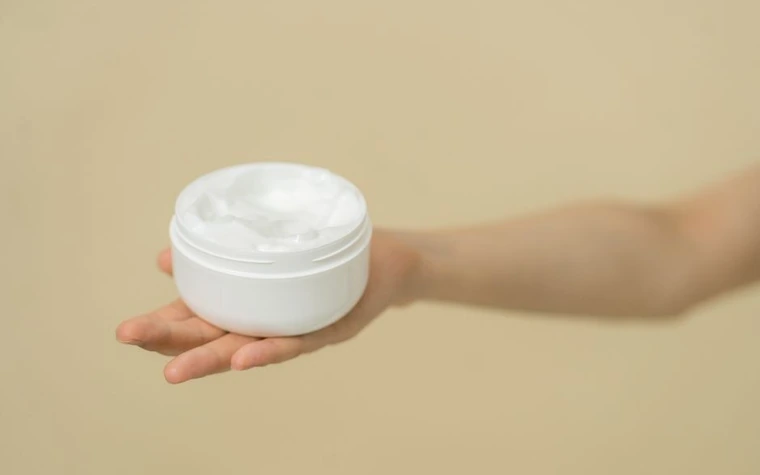
Petrolatum, dimethicone and similar occlusive agents reduce TEWL immediately by sitting on top and slowing evaporation. That is genuinely useful — it buys the skin time and comfort while it rebuilds — but it is a different mechanism from supplying the lipids the lamellae are made of.
The practical version: an occlusive manages the symptom now, physiological lipids address the structure over days. Most sensible barrier-focused moisturisers do both, which is why reading the whole ingredient list matters more than reading the claim on the front. If your moisturiser is doing only one of these jobs, it will feel like it works and then stop appearing to.
The step most people skip — stopping the cause
No lipid mixture outruns an ongoing insult. Before adding anything, the more productive move is subtracting whatever is disrupting the structure in the first place. In practice that is usually one of a short list:
- Exfoliating acids or physical scrubs used more often than the skin is clearing them
- A retinoid introduced at too high a frequency for the individual, rather than too high a strength
- High-pH or heavily surfactant-based cleansing, twice daily, on skin that does not need it — the mechanics of which are in double cleansing, explained
- Layering several actives at once so that no single one can be identified as the problem
- Hot water and long showers, particularly in winter
A reasonable approach is to strip the routine back to a gentle cleanser, a complete-lipid moisturiser and daily sunscreen, hold it there for two to four weeks, then reintroduce actives one at a time with a week between each. That timeline is not arbitrary — barrier recovery after disruption is measured in days to weeks, not hours, and reintroducing everything at once makes it impossible to tell what your skin is reacting to. Niacinamide is among the better-tolerated things to bring back first.
Where this stops being a skincare question
Much of the barrier-lipid research came out of studying conditions where the barrier is compromised as part of a diagnosed disease. That is precisely why the line has to be drawn clearly: persistent redness, itching, weeping, scaling that does not resolve, or symptoms that keep returning despite a simplified routine are not a cosmetic problem to solve with a better moisturiser. They warrant a dermatologist, who can diagnose and treat.
Cosmetic products support the skin's own structure and appearance. They do not treat conditions, and a routine adjustment is not a substitute for an assessment. If you have been cycling through barrier creams for months without improvement, the useful next step is an appointment, not another product.
What to check on the label
- Are all three lipid classes represented — a ceramide, a sterol (cholesterol or a phytosterol), and a fatty acid?
- Is there also an occlusive for immediate TEWL reduction, or only lipids?
- Is there a humectant such as glycerin to hold water at the surface?
- Does the formula avoid the actives you are currently reacting to, rather than adding more?
- Is the packaging opaque and air-limiting, given lipids oxidise?
A last framing note: barrier health is not a look, and the finish people associate with healthy skin comes from surface optics rather than from any single ingredient. That relationship is separated out in glass skin, decoded.
Sources and scope. Reference points cited: the stratum corneum "brick and mortar" model, in which corneocytes are embedded in intercellular lipid lamellae composed of ceramides, cholesterol and free fatty acids, with ceramides commonly reported at approximately 50% of intercellular lipid by mass; transepidermal water loss (TEWL) as the standard instrumental measure of permeability barrier function; and Man MQ, Feingold KR, Thornfeldt CR, Elias PM, "Optimization of Physiological Lipid Mixtures for Barrier Repair," Journal of Investigative Dermatology 1996;106(5):1096-1101, which reported that an equimolar ceramide:cholesterol:free fatty acid mixture permits normal barrier repair, that increasing any one of the three up to threefold accelerates repair, and that incomplete one- or two-component mixtures delay recovery. Verified August 2026. Reported lipid proportions vary with measurement method and body site. Patch-test any new product before regular use. Cosmetic products are not intended to diagnose, treat, cure or prevent any condition, and nothing here is a substitute for medical advice — persistent irritation, redness, itching or scaling should be assessed by a dermatologist.
All content is fact-checked under our editorial standards.