
Oat in Skincare, Explained: What the FDA's Colloidal Oatmeal Monograph Sets, What the USP Says It Is, and Why Oat Extract Is Not Oat Flour
Oat is one of the few skincare ingredients that has its own definition in a US federal rule and its own standard in a pharmacopeia. That makes it unusually easy to be precise about, and unusually easy to blur on a label. This guide covers what colloidal oatmeal is, what the FDA's skin protectant monograph actually sets, what the United States Pharmacopeia says about particle size, and why an oat extract is not the same thing as oat flour.
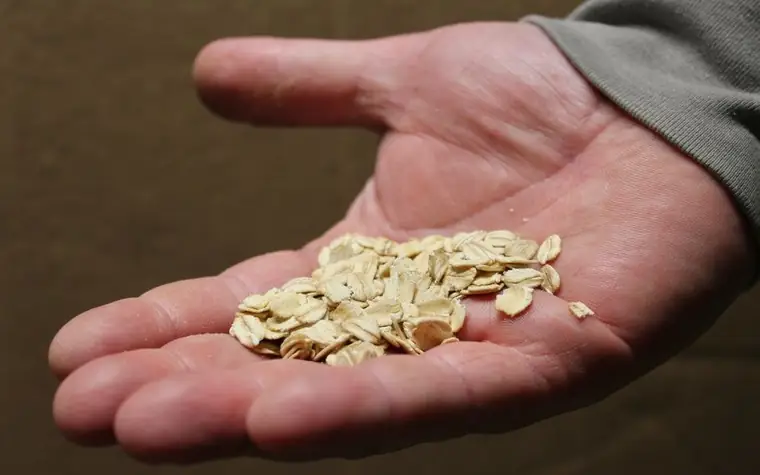
What colloidal oatmeal is
Colloidal oatmeal is finely ground whole oat grain. According to a 2007 review in the Journal of Drugs in Dermatology, the US Pharmacopeia defines it as the powder obtained from grinding and processing whole oat grain, with a fat content of not less than 0.2 percent, and with no more than 3 percent of particles larger than 150 micrometers and no more than 20 percent larger than 75 micrometers. The grind matters because the fine particles disperse in water and are described as depositing a thin film on skin.
What is inside the grain
The same review describes oat as rich in starch and in beta-glucan, a water-holding polysaccharide, with proteins, lipids and a family of phenolic compounds that includes avenanthramides. Starch and beta-glucan are the parts linked to the film and to water binding. For the sugar polymer on its own, see our explainer on beta-glucan. Lab work such as a 2008 paper in Archives of Dermatological Research reported anti-inflammatory and anti-itch activity for avenanthramides, but that is a statement about a purified compound, not a promise about a cream.
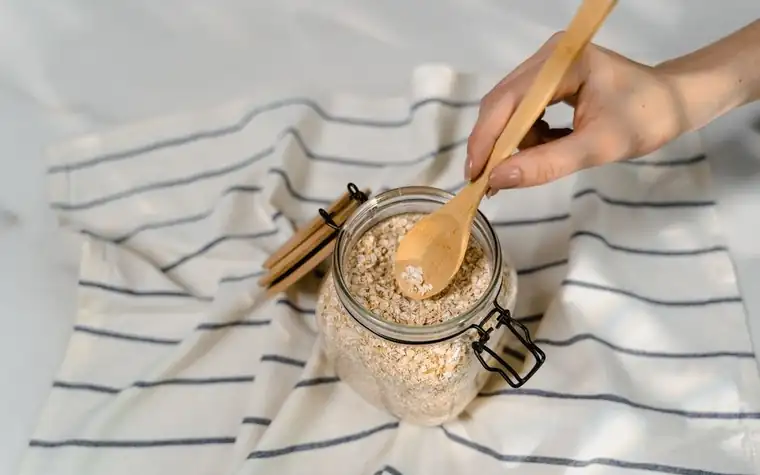
What the FDA monograph sets
The FDA first recognized colloidal oatmeal as a skin protectant ingredient in 1989, pending standardization, and the final monograph for skin protectant drug products followed in June 2003. Under 21 CFR 347.10, colloidal oatmeal must be present at a minimum of 0.007 percent, or 0.003 percent when combined with mineral oil. The 2007 review describes the 0.007 percent figure in the context of tub baths. Note the shape of the rule: it is a floor, not a ceiling or a dose, and it applies to products sold as skin protectant drugs. Our guides to allantoin and to petrolatum and mineral oil cover other ingredients in the same monograph.
Drug facts box versus cosmetic label
A product that lists colloidal oatmeal as an active ingredient with a percentage, in a Drug Facts panel, is following the monograph. A cosmetic toner or cream that names oat somewhere in its ingredient list is not required to meet that floor and does not make the same claims. Neither format tells you how much oat is in a cosmetic, because cosmetic ingredient lists are ordered by amount but do not state percentages.
Flour, colloidal oatmeal and extract are different
On a cosmetic label, whole ground oat commonly appears as oat kernel flour or as colloidal oatmeal, while an extract appears under a separate extract name. An extract is a solvent-derived fraction, so it will not carry the starch and beta-glucan film in the same way. When a product advertises oat, read the ingredient list for which form it is, and treat any claim built on the monograph as applying to the monograph form only.
What small studies have measured
The 2007 review cites a skin-irritation model in which oat extracts were applied under occlusion for two hours before a 24-hour patch of 1 percent sodium lauryl sulfate, and irritation was significantly lower on the pretreated sites. It also cites a study of 65 children aged 6 months to 2 years who were tested openly for 15 minutes and under patches for 24 and 48 hours, with no immediate urticarial or allergic reactions. Both are small and old, and the review's authors work for the maker of an oat product line, so read them as background rather than proof.
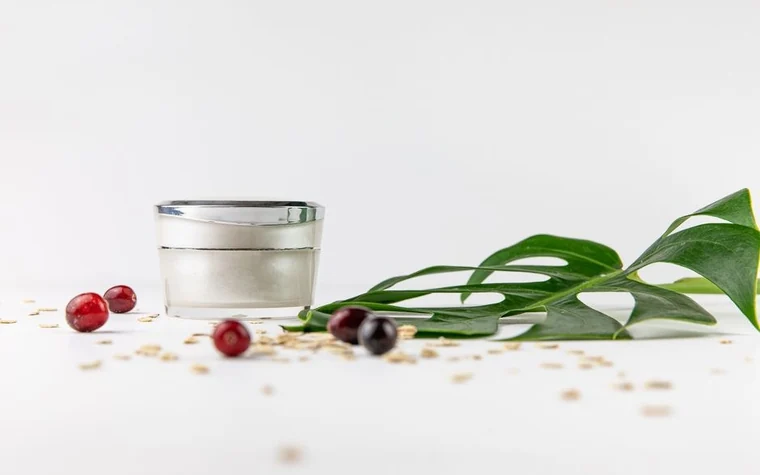
Where oat fits in a routine
Because oat is a grain, a clean result in a published study does not rule out a reaction in an individual, so patch-test first, ideally with our patch-test method. Oat-based products tend to appear as cleansers, creams and bath additives, usually in the gentle, low-fragrance part of a routine. The remaining checks are simple: find which form of oat is listed, confirm whether the label is a Drug Facts panel or a cosmetic list, and keep the rest of the routine unchanged for a week so any reaction can be traced.
Short version
Colloidal oatmeal is a defined, standardized powder with a regulatory floor of 0.007 percent in skin protectant drugs. Oat extract and oat flour on a cosmetic label are different materials with no such floor. This article is educational, not medical advice: patch-test any new product on a small area first, and consult a dermatologist about persistent skin problems.
All content is fact-checked under our editorial standards.