
Does Your Skin Type Change With Your Menstrual Cycle? What a 26-Study Review and Two Measurement Studies Found
Many people notice that their face feels tighter or shinier at certain points in the month and wonder whether their skin type has changed. The research is real but thinner than the "cycle syncing" posts suggest, and the numbers are modest.

What the question actually asks
Skin type is a label for how your skin behaves on an ordinary day. The cycle question is different: does the same skin, measured with instruments, drift between phases? For the seasonal version of that question, see what sebum and TEWL studies show across a year.
The widest view: a 2024 scoping review
Nguyen and colleagues (Cureus, 2024) screened 666 articles down to 26 on healthy women. Skin hydration showed no significant change across the three phases. Elasticity rose around ovulation compared with the follicular phase, and skin blood flow and basal temperature were higher in the luteal phase.
A 2025 study that did find a difference
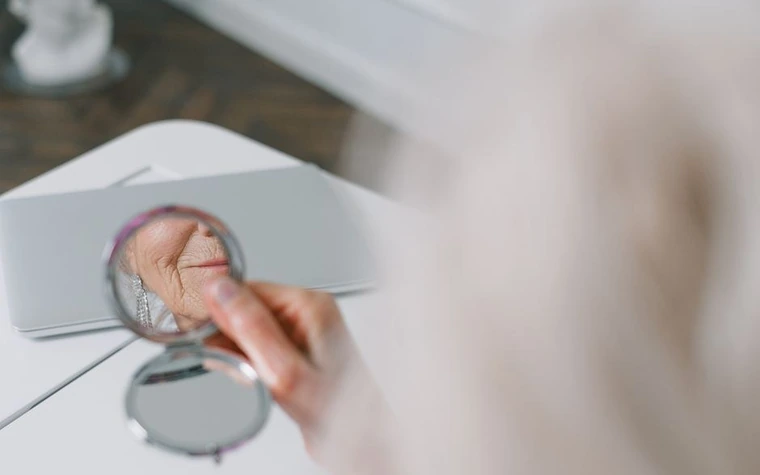
Nikoletić and colleagues (Skin Research & Technology, 2025) measured 36 women of reproductive age at ovulation and in the mid-luteal phase. TEWL was higher in the luteal phase (9.92 versus 8.87), and hydration was lower (36.27 versus 40.55, in the instrument's arbitrary units).
Why the two results do not cancel out
The review pooled many small studies with different instruments and timing, so a shift in one sample can vanish in the average. A single study with two time points can find a gap that does not replicate.
Irregular cycles: a different comparison
Ma and colleagues (BMC Women's Health, 2023) compared 197 women in Shanghai aged 18 to 35 by self-reported regularity. The irregular group had lower hydration and higher TEWL, both significant. Sebum was higher, but that difference was not significant. Regularity came from a questionnaire and the design was cross-sectional, so it shows association, not cause.
What this means for reading your own skin
If your skin feels different in the days before a period, the instrument data allow that. They do not show it is large, universal, or something a routine change fixes. Self-judgment is already unreliable, as the mismatch studies found, so one tight week proves little.
A practical way to test it without overhauling anything
Keep the routine fixed for two or three cycles and note dryness, shine and tightness on a few set days, such as the week after your period and the week before the next. Hormonal shifts also follow pregnancy; the postpartum piece covers what is and is not documented there.
This article summarizes published research and is not medical advice. Patch test any new product first, and see a dermatologist about any skin, hormonal or menstrual concern.
All content is fact-checked under our editorial standards.