
Reapplying Sunscreen Over Makeup: Why the Midday Dose Problem Has No Easy Fix
A sunscreen applied at eight in the morning is not doing the same job at one in the afternoon, and the gap has nothing to do with whether the person reapplied. It is a dose problem layered on top of a chemistry problem, and for anyone wearing makeup, the two combine into something close to a dead end: the product that protected skin at breakfast has partly broken down by lunch, and putting more of it on top of a finished face is not a simple top-up. The honest version of sunscreen advice for made-up skin is not "just reapply every two hours" — it is understanding why that instruction rarely happens as written, and what narrows the gap instead.
The morning dose was already thinner than the label assumed
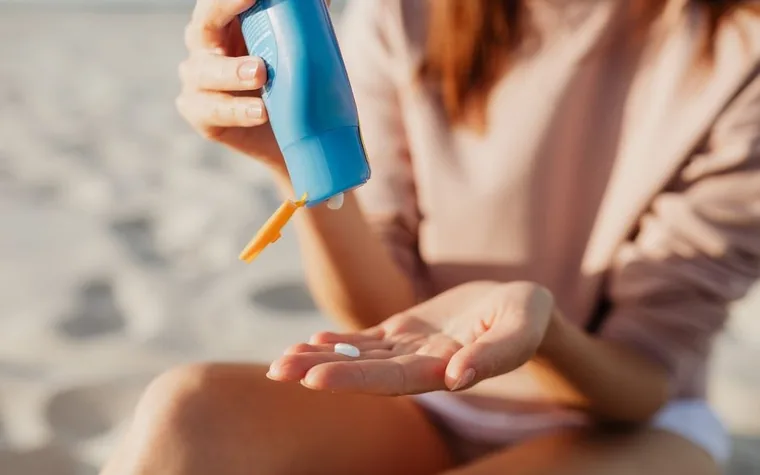
SPF numbers come from a lab measurement taken at a specific film thickness — 2 mg per square centimeter, applied once, under controlled UV output. Most people apply well under that on a normal morning, which already puts real-world protection below the number on the bottle before the day has started. That gap matters here because it means the starting point for the midday problem is not "full SPF that gradually fades" — it is a partial dose that then degrades further under sun, sweat, and friction. The two effects stack rather than cancel out.
What actually declines between application and midday
Two separate processes are happening under a layer of makeup, and only one of them is about the sunscreen wearing off physically. The first is photochemical: some organic UV filters absorb ultraviolet energy by changing shape, and a fraction of those molecules do not fully revert, so the filter pool available to absorb the next photon shrinks with continued sun exposure. Photostability studies on commercial sunscreens have found measurable degradation of UV filters after sunlight exposure even in products that were fully compliant with their labeled SPF at the moment they were tested, with degradation half-lives for some filters measured in tens of hours under continuous UV. The second process is mechanical: sebum, sweat, touching the face, phone contact, mask straps and collars all transfer product off the skin, and this happens whether or not makeup is on top. Makeup does not stop either process — a foundation layer sits on top of the sunscreen film, not inside a barrier that protects it.

"Just reapply" is written for bare skin
Reapplication guidance was developed for the scenario the SPF test itself resembles: bare skin, a fresh film, nothing underneath to disturb. Once foundation, concealer, powder, and setting spray are on the face, adding a normal-consistency sunscreen on top means dragging a wet or semi-wet product across a dry, powdery, or oil-based finish. The realistic outcomes are pilling, streaking, or a patchy film that sits unevenly because it is not bonding with skin the way it would on a clean face — it is bonding with whatever makeup ingredients are on the surface instead. None of that is a user error; it is a mismatch between how the reapplication instruction was written and the surface it is actually being applied to by midday.
Powder sunscreen: a thinner, less even film by design
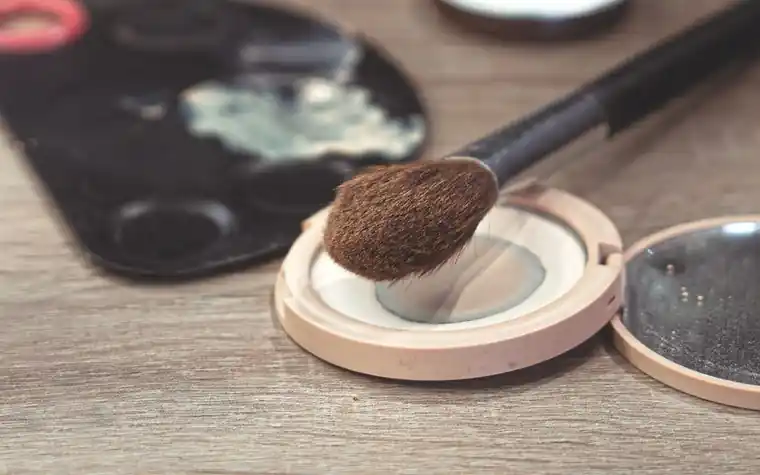
Pressed mineral powder sunscreen exists specifically to solve the makeup problem — it can be dusted on with a brush without disturbing a finished face. The trade-off is in how little product that method actually deposits. Consumer application studies on powder sunscreen have found that people apply a small fraction of a gram to the face per use, which — spread across the surface area of an adult face — works out to a film thickness well below the 2 mg/cm² standard the SPF number was measured at, and below what a cream reapplication would leave behind. Pressed powder also physically cannot flow into a continuous film the way a cream or lotion does; pigment particles sit next to each other rather than merging, so coverage is inherently more uneven at the pore and micro-relief level, even when the total amount applied looks generous on the sponge or brush. This is a formulation limitation, not a brand-specific failure — it is what pressing UV filters into a solid, dry compact does to how they can be distributed.
Spray sunscreen over makeup solves friction, not quantity
A fine mist avoids dragging a brush or fingers across makeup, which is the appeal, but a mist has the same underlying problem as powder from a different direction: much of what leaves the nozzle does not land on the face at the density the SPF test used, and getting enough of it to land without visibly wetting a finished look means most people stop misting before they have applied enough. Spray formats were not the format used to establish the labeled SPF, and applying "a few spritzes" over makeup is closer to a token gesture than a measured reapplication, even when it feels like the more makeup-friendly choice.
Does blotting first change any of this
Blotting the face with an oil-absorbing sheet before adding any sunscreen product does one useful thing: it removes surface sebum and some of the loose, already-degraded sunscreen residue sitting on top of the skin, giving whatever goes on next slightly better contact with the surface instead of sliding on a layer of oil. What it does not do is restore the dose. Blotting removes material; it does not add UV filter back. It is a sequencing step that can make a powder or cream touch-up adhere marginally better, not a substitute for the touch-up actually containing enough product to matter.
What is actually realistic for made-up skin
Given that a true midday reapplication over makeup is hard to execute at anything close to the tested dose, the more workable strategy shifts effort to the morning and to physical protection rather than to a repeat chemical application later. A single heavier morning application — closer to the two-finger measure for the face rather than a thin swipe — starts the day from a stronger baseline, since the degradation curve described above starts from wherever the morning film left off. Physical UV filters and newer, more photostable organic filters both still lose ground to UV, sweat, and time; the type of filter changes the chemistry involved, not the arithmetic of a film thinning out over hours, which is one reason even a newly approved filter does not solve the reapplication problem by itself. Shade, a wide-brimmed hat, UPF-rated fabric, and simply timing outdoor exposure around peak UV hours do something a partial powder touch-up cannot: they reduce the UV actually reaching skin rather than depending on however much filter survived on the surface. For anyone deciding between a mineral or an organic-filter formula for that morning base layer, the trade-offs are worth understanding before application, not after — what "mineral only" trades away is a separate decision from the reapplication problem, but it affects how the morning film behaves under sweat and touch. It is also worth revisiting how a sunscreen layer interacts with the steps underneath it, since a film that was compromised before makeup even went on will degrade from a lower starting point all day.
FAQ
Is a powder sunscreen touch-up better than no touch-up at all? Almost certainly yes as a partial measure, but it should not be treated as restoring full labeled SPF — the applied dose from a powder brush is well under the 2 mg/cm² the number was tested at.
Should I remove makeup and start over at midday instead? That gives the most complete reapplication but is impractical for most schedules; it is a reasonable choice before an afternoon with heavy sun exposure specifically, not a daily requirement.
Does SPF 50 make midday reapplication less necessary than SPF 30? A higher starting SPF gives more margin as the film degrades, but it does not stop the photochemical and mechanical processes described above — the degradation curve applies regardless of the starting number.
This article explains sunscreen chemistry and application mechanics and is not medical advice. Patch-test any new sunscreen or makeup product on a small area of skin before full-face use, and see a dermatologist for persistent skin concerns or a personalized sun-protection plan.
All content is fact-checked under our editorial standards.