
The Retinol Sandwich Method, Explained: What the 'Open Sandwich' vs. 'Full Sandwich' Study Found
The "retinol sandwich" is a layering order: a thin layer of moisturizer first, then the retinoid, then a second layer of moisturizer on top. It is also called buffering, and dermatologists have recommended some version of it for years as a way to make retinoids more tolerable without abandoning them. Until recently, though, the advice was based on clinical experience rather than a direct test of whether the technique changes what the retinoid actually does once it's diluted and covered.
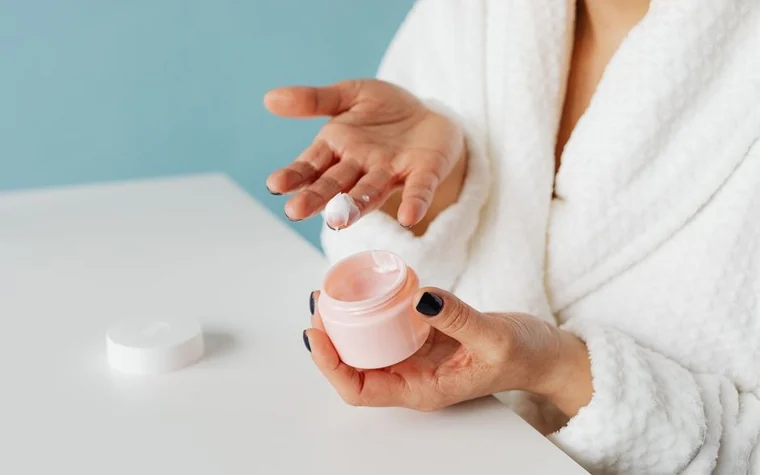
What the retinol sandwich method actually is
Why buffering exists: the irritation problem retinoids create
Topical retinoids increase epidermal cell turnover and, in the process, can strip away corneocytes faster than the barrier can replace them -- which shows up as redness, flaking, and stinging in the first weeks of use, especially at higher concentrations. That trade-off is exactly why regulators cap over-the-counter retinol strength; the same evening-routine logic that the EU's 0.3% retinol ceiling is built around applies here at the level of a single application. Buffering with moisturizer is one of the standard ways dermatology practices try to keep patients on a retinoid long enough to see results, rather than having them quit after a bad first week.
The study that finally tested whether sandwiching works
A poster presented at the American Academy of Dermatology's 2025 annual meeting treated human skin explants with tretinoin cream and retinol cream, either alone or layered with a lightweight water-gel moisturizer or a heavier water-cream moisturizer, then measured retinoid-driven gene expression -- specifically HBEGF and HAS-3, both markers used to track retinoid bioactivity in skin tissue. The design compared two layering patterns: an "open sandwich" (moisturizer plus retinoid, in either order, with no second moisturizer layer) and a "full sandwich" (moisturizer, then retinoid, then moisturizer again).
Open sandwich vs. full sandwich: the threefold difference
The open-sandwich pairing left retinoid bioactivity essentially unchanged compared to applying the retinoid alone. The full sandwich was different: bioactivity dropped by roughly threefold. The researchers attributed the drop to a combination of dilution -- the retinoid gets spread thinner between two moisturizer layers -- and a stronger barrier effect from the top layer slowing penetration into the skin. In other words, the extra step people add specifically to "protect" their skin from the retinoid is also the step most likely to blunt what the retinoid is doing.
The occlusion mechanism: why the top layer changes everything
Occlusion -- sealing the skin surface with a cream, ointment, or film -- is well documented to raise stratum corneum water content substantially within hours, and hydrated corneocytes generally become more permeable to many topical ingredients, not less. That's the counterintuitive part: a top moisturizer layer doesn't uniformly block penetration, and for some formulations it can increase it. The full-sandwich result in the explant study points to the opposite outcome for these particular retinoid creams -- less measured bioactivity -- which the researchers linked more to dilution and a physical diffusion barrier than to the hydration effect working in the retinoid's favor. It's a reminder that "occlusion helps absorption" is not a universal rule; it depends heavily on the specific molecule, vehicle, and moisturizer involved.
How to apply this to your own routine
The comparison used two specific moisturizer textures -- a water-gel formula and a water-cream formula -- alongside 0.025% tretinoin cream and 0.1% retinol cream, so it isn't a claim that every moisturizer behaves identically in a sandwich pattern. That detail matters for K-beauty routines specifically, where ampoules, essences, and gel-creams of very different thicknesses are commonly layered together, and a rich sleeping mask on top of a retinoid is a different physical setup than a light water-gel.
If irritation is the reason you're buffering, applying moisturizer before a retinoid (or right after it, without capping it again) looks like the version with an evidence base for preserving bioactivity. Going a step further and locking the retinoid between two moisturizer layers is the pattern most likely to work against you if your goal is results, not just comfort. If you're newer to retinoids and unsure how your skin will react at all, patch-testing the retinoid product itself first is still the more basic and more important step -- buffering technique doesn't substitute for confirming you tolerate the ingredient before working it into a nightly routine.
What this doesn't settle
An explant study measuring two gene markers over a short exposure window is not the same as a long-term clinical trial tracking wrinkle depth or acne counts in real users, and it used specific product concentrations rather than every retinol strength on the market. It also doesn't address a separate, common question: whether new redness or peeling in the first weeks is the retinoid working as expected or a sign to back off, which is a distinction covered in more detail when looking at how purging differs from an actual bad reaction. Sandwiching is also a separate question from why retinol goes at night in the first place -- the layering order within an evening routine and the buffering technique used on any given night are two different decisions.
Quick summary
- Open sandwich (moisturizer + retinoid, no second layer) preserved retinoid bioactivity essentially at the level of the retinoid alone.
- Full sandwich (moisturizer-retinoid-moisturizer) reduced measured bioactivity roughly threefold in the same study.
- The likely cause is dilution plus a stronger penetration barrier from the top layer, not the general "occlusion increases absorption" effect working here.
- The study used specific products (0.025% tretinoin, 0.1% retinol, one water-gel and one water-cream moisturizer) and short-term gene-expression markers, not a long-term clinical outcome.
- Buffering technique doesn't replace patch-testing a new retinoid before committing to nightly use.
Sources: poster presented at the American Academy of Dermatology Annual Meeting, March 7-11, 2025, Orlando, FL ("Tretinoin and Retinol Bioactivity Are Retained When Layered With Adjunctive Water Gel Moisturizer or a Water Cream Moisturizer in an 'Open Sandwich' Regimen"); Dermatology Times coverage of the same data; published dermatology literature on occlusion, stratum corneum hydration, and percutaneous absorption. This article explains layering-technique research and is not a treatment recommendation. Patch-test any new retinoid before regular use, and consult a board-certified dermatologist before changing how you apply one.
All content is fact-checked under our editorial standards.