
Bisabolol, Explained: What CIR's 1 Percent Leave-On Maximum Covers, Why It Is a Penetration Enhancer, and What Patch-Test Cases Say About Chamomile Allergy
Bisabolol turns up on soothing-skincare labels, often next to chamomile. The label rarely says how much is inside or whether it calms anything. This guide covers where it comes from, what the Cosmetic Ingredient Review (CIR) found about safety and use levels, why it is called a penetration enhancer, and what the case reports say about people who react to it. It also separates the lab and small-study results from the "soothing" claim.

What bisabolol is
The form used in cosmetics is (−)-alpha-bisabolol, an unsaturated terpene alcohol that CIR lists as a skin-conditioning and fragrance ingredient. It is the main component of chamomile (Chamomilla recutita) flower oil, which can contain up to 41.45 percent of it. Bisabolol can also be made synthetically, so a product that lists "bisabolol" alone is not necessarily using a chamomile extract.
What CIR concluded
CIR first reviewed bisabolol in 1999 and concluded it was safe as used. Its expert panel re-reviewed it and reaffirmed that conclusion, published in the International Journal of Toxicology in 2017. The 1999 conclusion rested on a 28-day rat skin study that found no effect level of 200 mg/kg a day, equal to a 4 percent solution. Moderate redness appeared at 20 percent. The panel also noted that a product containing 0.1 percent bisabolol did not cause sensitization in a clinical study.
How much is actually used
CIR's 2015 re-review draft counted 999 formulations containing bisabolol in the FDA's voluntary registration data, up from 184 in 1997. The industry survey it cites put the maximum reported concentration at 1 percent in leave-on products, such as lipsticks and makeup bases, and up to 0.5 percent in rinse-off products. Eye-area products ranged from 0.01 to 0.5 percent. Typical use in the 1990s was 0.1 to 0.2 percent, so a "contains bisabolol" claim usually means a small amount.

Why it is called a penetration enhancer
Animal studies showed bisabolol is well absorbed through skin, and a lab study showed it can help other substances pass through. The CIR panel asked manufacturers to be aware of this, especially in formulas that also contain propylene glycol. For a shopper it means a bisabolol product may carry its other ingredients deeper, which matters if you already react to fragrance or preservatives. In the draft, the European Union did not restrict bisabolol at all.
Chamomile allergy and cross-reaction
The draft summarizes several case reports. Seven children had reacted to a moisturizer containing bisabolol, and six of them had atopic dermatitis. When patch tested with 0.5 to 5 percent bisabolol, four reacted, and those four also reacted to a sesquiterpene lactone mix or a Compositae mix. Sixteen other children who had reacted to the same moisturizer did not react to bisabolol even at 5 percent. In a separate case, an adult's lip reaction traced to a lipstick tested positive at 5 percent bisabolol, while ten control subjects tested negative. People allergic to daisy-family plants may therefore want to patch test first.
Does it calm irritated skin
The draft says several studies of base creams with up to 0.5 percent bisabolol, in guinea pigs and in human volunteers, found no anti-irritant effect on irritation that had been induced on purpose. In one guinea pig study the cream appeared to make cumulative irritation worse. That does not prove bisabolol irritates, but it means "soothing" is not something these studies showed.
The lightening study in 28 women
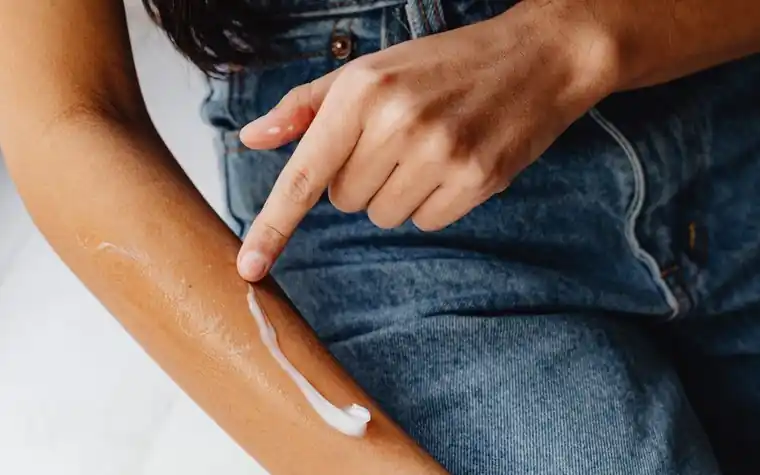
One study applied a 0.5 percent bisabolol cream once a day for eight weeks to 28 Asian women whose skin had been darkened with a UV solar simulator. Clinical and instrument measurements showed more lightening than with a control cream. Researchers proposed that bisabolol lowers a signaling molecule called cAMP in pigment cells. It was a small trial of induced tanning, so it does not show what happens with melasma or sun spots.
How to use this
- Expect a low percentage and judge the formula as a whole, not the buzzword
- If you react to chamomile or daisy-family plants, patch test using our patch test guide
- For a well-studied skin protectant, compare allantoin and centella asiatica
- If reactions keep coming back, see whether it is sensitive or sensitized skin
This article is general information, not medical advice. Cosmetic products do not treat or prevent disease. Patch test any new product and consult a dermatologist about skin concerns.
All content is fact-checked under our editorial standards.