
Retinaldehyde, Explained: The Retinoid One Conversion Step Closer to Retinoic Acid Than Retinol
Retinol gets most of the attention in cosmetic aisles, but it is not the retinoid closest to the form that actually binds retinoic acid receptors in skin. That title belongs to retinaldehyde (also written as retinal), a less-discussed vitamin A derivative that sits one enzymatic conversion step ahead of retinol on the same metabolic pathway. Where retinaldehyde falls in that sequence explains why formulators treat it differently from retinol, and why the comparative data that exists looks the way it does.

The Conversion Pathway, Step by Step
Topical vitamin A ingredients are not interchangeable forms of one molecule; they are stops along a metabolic chain. Retinyl esters, the mildest and most stable form, are hydrolyzed into retinol. Retinol is oxidized into retinaldehyde. Retinaldehyde is oxidized again into retinoic acid, the form that binds retinoic acid receptors and drives the signaling changes tied to skin cell turnover. Each arrow represents a conversion that has to happen inside skin cells before the applied ingredient resembles the active form.
Why Being One Step Closer Is Not Just a Marketing Line
Applied retinol must clear two conversion steps, retinol to retinaldehyde and then retinaldehyde to retinoic acid, before it resembles the receptor-active form. Retinaldehyde only needs one. That shorter distance is the rationale for expecting retinaldehyde to behave somewhat differently from retinol at an equivalent labeled percentage -- see retinol's own dose-response data for how that ceiling was established for the more common form. In practice, skin's conversion enzymes are a rate-limiting bottleneck at every step, which is also why formulators do not treat retinaldehyde as simply "stronger retinol" and dose it at lower percentages than retinol products.
What a Real Head-to-Head Trial Found
A frequently cited comparative trial, published by Creidi and colleagues in the late 1990s, randomized 125 patients with photoaged skin to 0.05% retinaldehyde cream, 0.05% retinoic acid cream, or a vehicle control, then measured wrinkle depth and roughness by optical profilometry over 44 weeks. Both active creams outperformed the vehicle, and the retinaldehyde group's results were not statistically distinguishable from the retinoic acid group's on those texture measurements. The meaningful difference between the two actives showed up in tolerability, not in the texture readouts.
The Tolerability Gap, With Numbers
A separate comparison (Fluhr et al., Dermatology, 1999) tested retinol, retinaldehyde, and retinoic acid under single-application and long-term conditions. Retinol and retinaldehyde showed statistically equivalent, low irritation potential, while retinoic acid produced a significantly more pronounced irritant response. Over extended use, roughly 44% of the retinoic-acid group reported erythema in the first month, with scaling and burning or pruritus each affecting close to a third of participants; retinaldehyde produced those reactions at significantly lower rates. That gap is generally attributed to how retinaldehyde is handled inside the cell: a meaningful share of what's applied gets shunted back toward storage as retinyl esters rather than pushed forward to receptor-active retinoic acid, blunting the receptor-overload effect behind classic "retinization" irritation.
What Concentrations Actually Show Up in Formulations
Retinaldehyde is formulated at noticeably lower percentages than retinol. A randomized, double-blind trial by Kwon and colleagues (Journal of Cosmetic Dermatology, 2018) compared 0.1% and 0.05% retinaldehyde creams in 40 volunteers over three months, tracking wrinkle and texture parameters at the crow's feet; both concentrations were well tolerated. Across the published literature, 0.05% to 0.1% is the range that keeps recurring for retinaldehyde, versus the roughly 0.1% to 0.3% range more commonly discussed for retinol. That fits with retinaldehyde needing less raw material to reach a comparable downstream signal, since less conversion stands between the applied ingredient and the receptor-active form.
What This Means for Skin, in Mechanism Terms
Once retinoic acid forms, it binds nuclear receptors and alters gene expression tied to keratinocyte turnover and collagen-related signaling in the dermis, the shared mechanism behind every retinoid regardless of the starting form. Retinaldehyde's practical difference from retinol is about how efficiently it reaches that endpoint, not a different endpoint altogether. This describes a cosmetic mechanism, not a treatment claim: retinaldehyde products are not medications, and if you're dealing with a diagnosed condition such as acne or rosacea, that's a conversation for a dermatologist rather than a cosmetic ingredient.

Formulation and Stability Notes
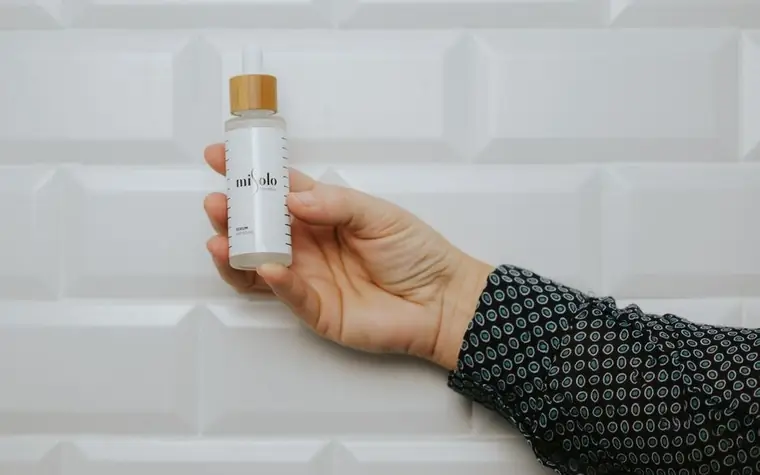
Retinaldehyde oxidizes faster than retinol in an open jar, part of why it typically ships in airless pump or dropper packaging with antioxidant stabilizers rather than open tubs. It's usually positioned as a nighttime-only step, since aldehydes tend to degrade under UV exposure, which is also why daytime sun protection matters alongside it.
Who Might Consider This Ingredient
Retinaldehyde tends to come up for people who have already tried retinol, tolerated it well, and are curious about a form with a shorter conversion path and a published tolerability edge over prescription tretinoin, without stepping up to a prescription strength. It is not automatically "better" than retinol for everyone; it is a different point on the same pathway, formulated lower for reasons rooted in that pathway -- much like how bakuchiol compares to retinol in a head-to-head trial, retinaldehyde is a different tool on the same shelf rather than a strict upgrade. It's also worth knowing why the EU capped retinol at 0.3%, since that same regulatory logic shapes how brands formulate retinaldehyde products for different markets, and how pairing vitamin C in the morning with a retinoid at night applies just as directly to retinaldehyde as it does to retinol. As with any retinoid, introduce it gradually, patch-test a new product on a small area of skin first, and check with a dermatologist before adding it to your routine if you have sensitive skin, are pregnant, or are already using other active ingredients.
All content is fact-checked under our editorial standards.