
Closed Comedones, Explained: The Follicular Plug Mechanism — and Why They're Not Milia
"Whitehead" gets used for two things that look almost identical and form in completely different ways. A closed comedone forms inside a hair follicle that still, technically, communicates with the surface — the opening is just narrowed and covered by a thin layer of skin. A milium has no follicular opening at all; it is a self-contained keratin cyst sealed under intact epidermis, which is why milia don't respond to acids or extraction pressure the way closed comedones do. That distinction is the whole reason one bump can be worked with and the other, mechanically, cannot. The rest of this piece is about the one that can: what is actually inside a closed comedone, why the follicle got blocked, and what changes the plug's fate.

A closed comedone has an opening. A milium doesn't.
What's actually inside the plug
A comedo — open or closed — is the same basic material: sebum and desquamated keratinocytes packed into the follicular canal, sometimes alongside bacterial byproducts from the skin's resident microbiome. Cunliffe, Holland and Jeremy's 2004 review in Clinics in Dermatology describes this plug as forming when cells shed from the follicle's inner lining fail to separate and clear normally, so they accumulate as a cohesive mass rather than shedding one layer at a time. Sebum keeps arriving from the attached sebaceous gland and has nowhere to go, so it gets folded into the same blockage. What differs between a closed and an open comedone is not the ingredients — it's whether that plug has any exposure to air.
Why the follicle gets blocked in the first place
The process is called follicular hyperkeratinization: the corneocytes lining the follicle wall multiply and stick together instead of detaching and shedding on schedule. Two factors are consistently named as drivers. Sebum composition changes — a drop in linoleic acid relative to other lipids has been linked to a more scaling, less cohesive lining, which paradoxically makes cells clump rather than separate. And androgen activity, specifically dihydrotestosterone acting on the sebaceous gland and the follicular lining, increases both sebum output and the abnormal proliferation of those lining cells. Neither factor is something a topical product changes at the source — they describe why the follicle narrows, not a step you can reverse by washing more.
The microcomedone: acne's actual starting point
Every visible comedone starts as something too small to see. Jean-Hilaire Saurat's 2015 paper in Dermatology, "Strategic Targets in Acne: The Comedone Switch in Question," frames the microcomedone as the decision point — the moment a normal sebaceous follicle either stays normal or is switched into the acne pathway. Past that switch, the follicle can widen into a visible comedone; before it, there is nothing to see or treat. This is part of why comedonal acne is described as a slow-building process rather than something that appears overnight: the visible bump is downstream of a change that was already underway beneath the surface.
Why one stays white and the other turns black
Once a comedone is large enough to see, whether it looks white or black comes down to one variable: air exposure, not hygiene. An open comedone — a blackhead — has a follicular opening wide enough that the plug's surface is exposed. The dark color is oxidized melanin and lipid within the plug, the same basic browning reaction as a cut apple left on a counter, not trapped dirt. A closed comedone has that opening narrowed and covered by a thin layer of epidermis, so the same plug material never oxidizes and stays pale. No amount of cleansing changes which one a given follicle becomes — that is decided by how much the opening constricted, not by what touched the skin afterward.
The lifecycle is short — which is why picking makes it worse
Comedones are not permanent fixtures. The Cunliffe review notes that in observed cases, many closed comedones resolved within about 12 days, and blackheads that were manually extracted refilled within two to six weeks — the follicle simply repeats the same hyperkeratinization process that formed the first plug. That second number is the practical argument against repeat DIY extraction: squeezing a comedone does not correct the underlying cell-shedding problem, so the same spot tends to fill again on its own timeline regardless of how it was emptied. Squeezing also risks something the follicle's own lifecycle doesn't: forcing plug material through the follicle wall into surrounding tissue, which triggers the inflammatory response that turns a comedone into a papule or pustule. The red or brown marks that follow an inflamed breakout are a direct consequence of that kind of mechanical injury, not of the original comedone itself.
Where topical ingredients fit, and where they stop
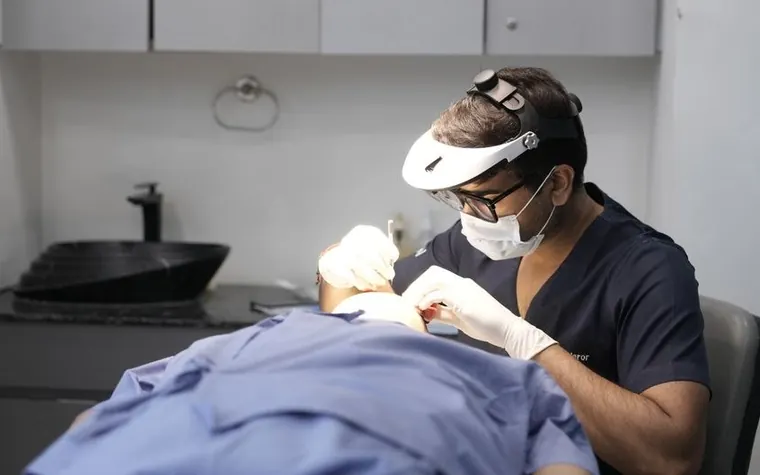
The ingredient categories dermatologists reach for here are described as comedolytic — they work on the hyperkeratinization step, not on an existing plug directly. Salicylic acid is lipid-soluble enough to move into the follicle and loosen the bond between the stuck-together corneocytes, while retinoids act earlier, normalizing how quickly those follicle-lining cells turn over in the first place. Both act on the mechanism described above — they do not dissolve a plug the way heat dissolves wax. That is also why the visible improvement takes weeks, not days: the follicle has to complete new, more normal shedding cycles before the narrowing resolves. For a comedone that isn't clearing, or skin with widespread comedonal acne rather than the occasional bump, a dermatologist can extract a comedone with a sterile tool under controlled pressure — a fundamentally different action than fingers, precisely because it targets the follicle opening without forcing material sideways into the surrounding tissue.
Summary
- What it is: a hair follicle blocked with sebum and stuck-together corneocytes, with a narrowed but still-present opening to the surface.
- How it differs from a milium: milia have no follicular opening at all and sit as sealed cysts — that's why acids and extraction pressure work on one and not the other.
- Why it's white, not black: the plug isn't exposed to air, so its melanin and lipid content never oxidizes.
- Why it comes back after picking: extraction empties the follicle but doesn't change the hyperkeratinization that filled it, so the same spot can refill within weeks.
- What actually changes the mechanism: comedolytic ingredients acting on cell turnover over several weeks, or professional extraction with sterile technique — not repeated squeezing.
Sources: Cunliffe WJ, Holland DB, Jeremy A. "Comedone formation: etiology, clinical presentation, and treatment." Clinics in Dermatology, 2004;22:367-374. Saurat J-H. "Strategic Targets in Acne: The Comedone Switch in Question." Dermatology, 2015;231(2):105-111. This article explains general follicular biology and is not a diagnosis. Patch-test any new skincare product on a small area before regular use, and see a board-certified dermatologist for persistent comedonal acne or before attempting any extraction.
All content is fact-checked under our editorial standards.